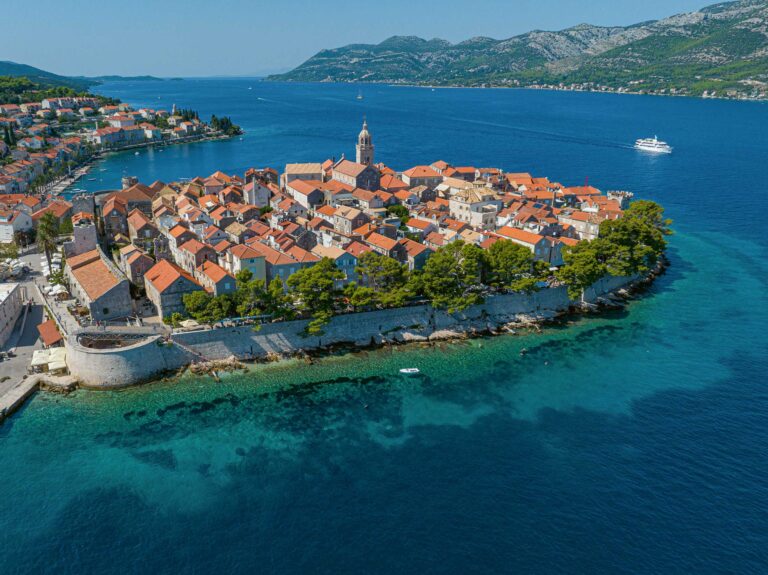

With the exception of the Pelješac Channel, there is little sailing north of the island of Korčula. The majority of seafarers who want to go from Korčula to Vela Luka or vice versa, weather permitting, choose a route along the southern coast of the island. There are several beautiful coves and small villages. The little islands of Veliki Pržnjak, Mali Pržnjak, Zvirovnik and Stupa, Crklica, Sridnjak and Vrhovnjak, which protect Prižba from the south. From the northern side, between Vela Luka and Račišće, we won’t find a large community except for Prigradica, somewhat halfway between them.

Built as one of the ports of Blato, Prigradica is one of the largest communities in the interior of the Adriatic islands. For decades, Prigradica served as a place for loading wine. From here sailed passenger ships that transported the island population to overseas countries. Only on one day, April 25, 1925, 1,200 people departed from Blato and Vela Luka. Today, not counting summer seafarers and a few fishermen with catamarans on the Split-Korčula route, boats rarely sail here.
There is a fair amount of room. The 300-meter-long waterfront on the southeastern coast of the cove is protected by a 100-meter-long pier with a high breakwater and port light at the top. Along the waterfront, domestic boats have comfortable berths, a fair distance from each other. There is plenty of space between them and if you drop anchor, you can moor the boat stern-to-pier. At the breakwater you can moor sideways but must take into account that a catamaran arrives here and leave room for it at the very end.
The water is deep enough everywhere. Along the breakwater, the sea is 2.7 to 4.5 meters deep and along the waterfront, 2 to 3 meters. A little further from the end, it is even deeper, and in the center of the cove a full 15 meters. When a strong northwestern wind is blowing, the sea in the cove swells and it is best to moor along the breakwater.
A fishing village
Prigradica has retained the appearance of a typical fishing village. Despite the new houses built on the western shore of the port, old stone houses still predominate. At the bottom of the cove is one of the most beautiful inner ports in the Adriatic. The owners of the fishing boats there have long ceased fishing professionally and only fish for themselves. Nevertheless, if you come across someone with a good catch, you can buy fish that have just been taken from the sea. It will not be a problem for those fish to swim two more times. Once in oil and the second time in wine.
Between Prigradica and Blato 4 kilometers away, are some of the best olive groves on Korčula, as well as some old vineyards. During the summer, it is fairly quiet here. The sea is clean and clear, so people swim in the port, on the cliffs, and at the pebble beach beyond. If you are hungry or thirsty, there are the inevitable café, the tavern Kraljević and the restaurant Prigradica to choose from. Of course, there is also a little store.
Should you wish to become better acquainted with the island, its way of life and customs, you have an excellent opportunity to do so if you take a walk or drive 4 kilometers to Blato. Located on the periphery of the fertile Blato field (Blatsko Polje), many unjustifiably call Blato the largest village in the interior of the Adriatic islands. However, despite the fact that its inhabitants are engaged in farming, it is not a village. It is a genuine little town, with an urban layout of its narrow streets, rows of trees, park, church with a tall belfry and spacious square with a loggia, where in the summer, especially during the knightly tournaments, an important island dance, kumpanija, is presented. This is a men’s sword dance, performed in several other places besides Blato.