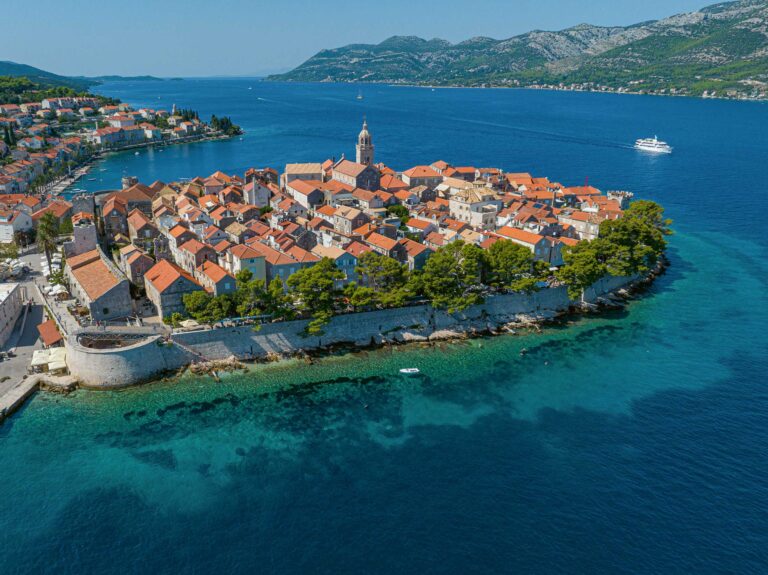

The first place that comes to mind when Grk is mentioned is Korčula, more precisely Lumbarda on its southeastern coast. This grape variety is traditionally grown on the island, with smaller quantities cultivated on neighbouring Vis and Brač, as well as on the Pelješac Peninsula. It was once grown on Lastovo too, the most remote inhabited island in the Adriatic. We first learned that Grk had returned to Lastovo and that Hropić Winery was producing a wine of outstanding quality from Tonči Jurica, a fisherman, chef and owner of the Triton restaurant in Zaklopatica on Lastovo. The senior members of our editorial team have been friends with him for decades and trust his judgement when it comes to quality.
So we took his recommendation seriously. Not only did he recommend the young winemaker and winegrower Lukša Hropić, he sang his praises. The idea of making our way to Lastovo had been maturing for almost 2 years, but something always seemed to get in the way. This time, we finally made the journey, and we are certain we shall return soon. We first tasted Hropić’s 2022 Grk at Triton, where it proved a splendid companion to a fish dinner.
Hropić Winery Works Closely with Mentors from Korčula
The following day, we met Lukša Hropić at his winery. Small but beautifully appointed and equipped with modern technology, it occupies the ground floor of his old stone house. If the town of Lastovo is imagined as an amphitheatre, his winery stands on its stage, or perhaps just behind the curtain. It is right beside the square where the renowned Lastovo Carnival takes place. We spoke to Lukša about his academic path, his beginnings in winemaking and the friendships he has forged with Korčula’s winemakers. It was there that the celebrated oenologist and winemaker Janko Jovanov took him under his wing. Lukša speaks of him as a second father and is equally full of praise for his cooperation with the island’s other winemakers.
“University teaches you how to think, gives you a grounding in theory, broadens your horizons and introduces you to many people. But when it comes to the craft itself, I learned most from Janko: a way of thinking, how to approach wine… From Franko Milina Bire, I learned how to approach the work and the importance of impeccable hygiene, which is essential to making exceptional wine. Just as every single step in the process is.” To all this, Lukša added his own experience.
A Lifetime in the Family Vineyard
The young Lastovo winemaker has yet another reason to be happy. On Korčula, alongside mentors who taught him about wine and particularly about Grk, as well as friends and business associates, he also met his wife Daria, with whom he has a son, Luka.

Born and raised on Lastovo, Lukša had accompanied his grandfather to the vineyard since early childhood. At first, the thrill lay in driving the tractor, but in time he grew to love tending the vines as well. After completing forestry school in Karlovac, he considered enrolling at the Faculty of Forestry in Zagreb, but ultimately decided against it. “What would I do with a forestry degree on an island?”
Lukša tells us that he has always regarded himself as a practical man. After completing a three-year undergraduate degree in Mediterranean Agriculture in Split, he enrolled in a graduate programme in Zagreb. Competition for the winemaking course was particularly fierce that year, so he chose Organic Agriculture instead and, by submitting individual applications, completed all the winemaking subjects.
In Zagreb, he shared a room with Matej, a native of Korčula and the son of the celebrated winemaker Janko Jovanov, who passed away recently. Lukša and Matej studied together and became friends, and Lukša began travelling to Korčula for the grape harvest. There he met Bire, Zure and the other winemakers of the neighbouring island. His graduate thesis focused on piculja, an indigenous Lastovo olive variety. Nevertheless, “winegrowing won out, because more substantial results can be achieved on a smaller area. To make a living from olive growing, I would need more than 1000, perhaps even 1,500 trees.”
Lastovo’s New Grk Vineyards Are Only 10 Years Old
Lukša owned some family land, which he cleared. Beside it lay a plot belonging to the Church, which he leased.
“My family always had 7-8000 vines, going back to my grandfather’s vineyard. The grapes once went to the winery, to the cooperative. When the cooperative collapsed, their vineyard shrank too, leaving around 3,500 thousand vines. There were all sorts of varieties: kuč, maraština, plavac, babić… It was a typical socialist-era vineyard, planted with varieties that yielded large quantities of wine. The quality was nothing exceptional, but people worked and sold what they produced,” Lukša explains. “Little by little, I cleared almost all of it. About 500 old maraština vines remained, and I planted some new ones as well.”
This began in 2016, immediately after he completed his studies, when Lukša started planting his first vineyard. His Grk vines are therefore only 10 years old. The maraština vines are old, and he also buys grapes of this variety from local growers. Spending time with oenologists and producers on Korčula introduced him to the potential of Grk, a variety they have elevated to remarkable heights.
Throughout his winegrowing journey, Lukša has received invaluable help from his parents, Margaret and Luka. We witnessed their support first-hand. Daria and their son Luka came to greet us and brought sliced cured meats and bread during the tasting, while out in the vineyard his father, Luka, was just finishing mowing the grass.
The Finest Grk in Austria-Hungary Once Came from Lastovo
As a child, Lukša spent a great deal of time with his grandfather Luka and the older islanders. It was from them that he heard a story about a Lastovo winegrower who, some 100 years ago, cultivated a vineyard in the same area as his own and received an Austro-Hungarian award for the quality of his Grk. The arrival of phylloxera swept it all away. Socialism later ushered in an age when quantity mattered most, and Grk, although a variety of great quality, produces modest yields. This gave Lukša the idea of reviving it in the very same place.
Owing to its distinctive hilly terrain, Lastovo has a total of 46 fertile fields. Interestingly, Lukša’s vineyards stand on sandy soil, just like the finest vineyards on Korčula. The microclimate, however, is different, lending Lastovo’s Grk a character of its own. The vines are not directly exposed to the sea or carried sea salt, as the vineyard is sheltered by high hills.

His First Lastovo Grk Label Came from the Challenging 2019 Vintage
Lukša planted Grk in 2017 and gathered his first harvest in 2019. It yielded only a few hundred litres. He bottled his first Grk the following year, and 2 years later introduced his first official Grk label.
Alongside it, he also bottled a maraština, while this year has brought his first rosé and a cuvée of Merlot, Cabernet and Plavac Mali. We had the opportunity to taste them all. At the winery, we were also among the first to sample the 2023 Grk, which had only just reached maturity. Even older winemakers have told Lukša that 2023 was an exceptionally demanding year. Despite all the challenges, he is more than pleased with every one of his wines, and we wholeheartedly agree.
For now, Hropić Winery has no tasting room of its own. Lukša welcomes visitors either inside the winery or in the neighbouring traditional wine cellar, but a dedicated tasting room is part of his plans. So are new vineyards. Beside the existing vineyard, we visited newly planted vines that barely reached above ankle height. Lukša had carefully covered them with soil over the winter to protect them from frost and had uncovered them only a few days before our arrival.
The Wine Envelope
He has also received funding through the Wine Envelope, a support programme administered by the Ministry of Agriculture for investment in wineries and marketing. Hropić wines are currently distributed directly from the winery and can be found in a growing number of highly regarded restaurants in Zagreb and along the coast. These include several establishments holding Michelin stars and other prestigious distinctions. On Lastovo, Lukša supplies restaurants that introduce his wines to visitors, with boaters playing an important role among their guests.
Written by: Teo Marević
Photos by: Braslav Karlić and Teo Marević