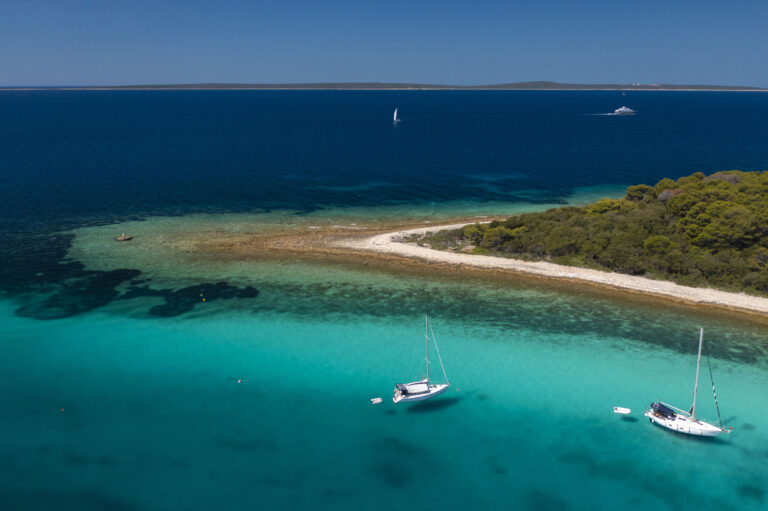
Pag is an island not reached by the main nautical routes. As the fifth largest and most fragmented Adriatic island without competition, Pag has not had much luck with sailors. At least not with those who sail the Adriatic for pleasure or charter sailboats and motorboats. The island has elongated shape, with deep bays in the south and the Bay of Pag, resembling a glassy lake in calm weather (in Croatian, bonaca), and it abounds in beaches in secluded bays.
In reality, the waters around Pag belong to those boating enthusiasts who frequent it much less often. Their routes, from north to south, lead mainly along the outer line of islands from Lošinj to Dugi otok. Thus, the southwestern coast of Pag is somehow left aside. Even more so is the northeastern side, facing Velebit and the gusty winds (in Croatian, bura), because it lies in the Adriatic, undoubtedly, the least navigable waters. Excluding Novalja and the marina in Šimuni, there have not been significant investments in nearby ports and harbors. Consequently, there are not many available berths for boats in transit.
Adriatic you are not used to…
Does it make any sense then to sail to the island known for its salt, sheep, cheese, and, in recent decades, unbridled entertainment? Indeed, it does. Because from the boat, you can experience the Adriatic, different from the one we are used to. Having to probably make the effort to find a berth and to pay more attention to the weather forecast should not sway you from the intention. Ultimately, you will be abundantly rewarded.
After landing in one of the small ports on that peninsula, pointing toward Rab like an outstretched finger, you can experience the olive groves of Lun. Those who want to see what having fun in Ibiza is like will choose Novalja and nearby Zrće. In the town of Pag, unique for its urban character, lace and saltworks, you sail into the 15th century, the time of its construction according to rules reminiscent of ancient Rome. If wanting complete desolation, you should anchor in the ports of Povljana or Dinjiška. To say nothing of the barrenness of its northern foreshore and the moonlike landscape not to be found anywhere else.
Olive Gardens of Lun
As Pag is usually reached from the Kvarner islands or the mainland coast, the first encounter with the island is the long Lun peninsula. After mooring Tovarnele, the northernmost port of Pag, or in Jakišnica, slightly further south, you find yourselves in surroundings quite different from the rest of the island as it is the greenest. If the bare northern coasts excluded, thousands and thousands of olive trees grow in this area.
Estimates indicate about 80,000 such trees, and who knows how many holm oak trees. Indeed, Lun is best known for the many (approx. 1,500) olive trees that have roots dating back to the distant past. Those who study them say that they are at least 1,500 and possibly even 2,000 years old. The imposing Methuselahs were born by grafting the oblica (a specific type of olive) onto wild olives. This cultivation method has remained to this day.
Despite the recent times in which everything that requires hard physical work is seen as less valuable, olive trees are a way of life for the local inhabitants, just as it was for their ancestors. So take the opportunity to visit the Tovarnele Presentation Center to learn about olive trees and take a stroll to Lun to see them. You will see the spirit and love nurtured by the locals, how important organic production is to them, how they tend sheep that graze freely among the olive trees, build and restore dry stone walls, and take care of the olives neglected by owners who have emigrated. Here, make sure you also buy a bottle of oil, and if you’re in for a good meal, visit Davor Badurina’s Palma in Jakišnica.
Having left Lun, you arrive at its origin and the more than two-mile-long bay of Stara Novalja on its northern side and the large port of Novalja on the south side, still surrounded by greenery in areas that have not been overrun by mass construction. This is especially the case in Novalja, which in the twenty-five years has turned into a resort for those looking to party all night. While the main events take place on Zrće beach, the other shore of the island, that somewhat wild atmosphere can also be felt in Novalja, so consider that if you plan to come here.
A port for fishermen and boaters
The port of Novalja is wide, facing west, and is exposed to storms. Finding a safe berth in it is important. The locals know this well. To protect the waterfront promenade and a section of the port, a pier more than 200 meters long with a shell-covered surface was built in stages, to which a pontoon was later added. This was not sufficient for the fast-growing place, so a few hundred meters to the west, another pier was backfilled, behind which wooden skiffs belonging to the locals were moored. This pier is equipped with moorings, electricity and water, and is the responsibility of the County Port Authority of Novalja.
Places accommodating 20 or more vessels in transit can be found on the first pier. But since in Kvarnerić, a sizeable fleet of purse seines go out to fish in the open sea at night, Novalja has become their closest landing dock, thanks to the bridge connecting Pag to the mainland, only 60 kilometers from the motorway. Because of them, the outer pier was completely refurbished and upgraded, becoming a fishing port. It certainly benefits the fishermen, but the consequences were felt by boaters. Local boats, and also yachts, as there are a large number of them, had to relocate to the inner pier, reducing the number of berths for transiting vessels. Following the completion of a new fishing pier and the installation of moored pontoons providing communal berths, reconstruction and extension of the southern breakwater in Novalja has commenced. The head of the existing breakwater will be extended by approximately 20 metres, followed by the construction of a new 140-metre section extending southwards. The outer quay of the new breakwater arm will be operational on both sides. New floating pontoons will be moored perpendicular to the breakwater, and mooring lines will be installed to allow stern-to berthing along the wall. Around twenty berths will be designated for yachts in transit.
If unable to find a berth, the only other option is anchorage. Given that the port is quite shallow and the depth in its inner section does not exceed 5 meters, about 10 buoys are anchored in it during the tourist season and managed by the local port authority. The regular catamaran line and excursion boats use berths on the waterfront promenade and pier.
Most of what the town has to offer relates to all-night parties and fast food restaurants, along with various types of bistros. Naturally, if you have acquaintances among the locals, you will also find places with much more local flair like pizza tavern called Pod zvon. The nice atmosphere, good food, friendly and fast waiters and the pleasant bill makes it a place worth dining.
Michelin Star, sheep and cheese
To get from Novalja to Stara Novalja, you need to sail almost 23 miles around Lun. Though only a few kilometers over the hill, the best way to get there is by car if you do not intend to sail along the Velebit Channel onward around the northern coast of the island.
Stara Novalja (Old Novalja) is anything but old today. The former miniature settlement stretches across three rows of newly built, rather large houses, a full 3 kilometers along the northern shore of the bay, almost all the way to the ferry dock. Fortunately, the beach at the end of the bay and the entire southern coast remained pristine. For those sailing here, Stara Novalja does not offer much. There are no moorings available in the settlement. Of course, toward the end of the 2.2-mile-long bay, finding anchor and protection from the bura is possible, but not from the Tramontana. Next to the ferry dock on Cape Deda is a waterfront promenade where a dozen boats can be moored, and there is a plateau used for hauling the boats out and servicing them. The port authority also manages this facility. Sometimes, a berth can be found there.
Boškinac
This part of the island also includes Boškinac, one of the most important Adriatic cuisine and family tourist projects. Boris Šuljić, the man who opened Kalypso – the first small beach bar on Zrće – 40 years ago, is credited with starting the transformation of Zrće beach into what it is today.
He has embarked on a different project a few kilometers away. On the wooded slopes of the hill above the land strip that connects Stara Novalja and Pag Bay, he has built a luxury family hotel with a restaurant and a wine cellar, surrounded by olive groves and vineyards. Being persistent and nurturing a vision to preserve and perfect the tradition of Pag, he has created a place for the highest level of relaxation and fine dining. With the help of the chef, Matija Bregeš, he has been awarded and still maintains the Michelin Star. He has also added high-quality wines carrying the Boškinac label, which have great aging potential. If you visit this part of the island and want to experience creations from seasonal island ingredients and top comfort, Boškinac is the right place.
Renowned Lamb
Speaking of delicacies, Pag has always been an island known for its sheep husbandry, lamb meat and cheese. In the Adriatic region, Brač follows closely when it comes to sheep breeding, but no chance of catching up. The people of Pag, despite all the challenges of modern tourism, have not neglected cattle breeding, and wherever you go on the island, you will come across the local variety of sheep, the pramenka, in the fields and rocky areas. Dry stone walls crisscrossing the entire island, often descending all the way to the sea, like the ones in Kornati, keep the herds together.
Cheese movement
By springtime, most of the island’s renowned Pag lamb has already reached the table, while milking continues. Their milk, with salt added, is used to obtain the famous product of the island – Pag cheese. Long ago, the cheese was usually made by the island’s shepherds, but when branded by the Pag Cheese Factory 70 years ago and it began to win international fame, the production of Pag cheese became a movement. Today, it can be found among small sheep breeders but also among cheesemakers who have modernized their production to produce several hundred tons of it a year.
The most famous among them are MIH and Gligora which has the largest plant on the island. Both are located in Kolan, have their own parent herds, collaborate with other sheep farmers and produce several types of cheese, including cow cheese. If the opportunity arises, visit them, try their cheeses, tour the production facility and make a purchase. You won’t regret it.
The only marina on the Island
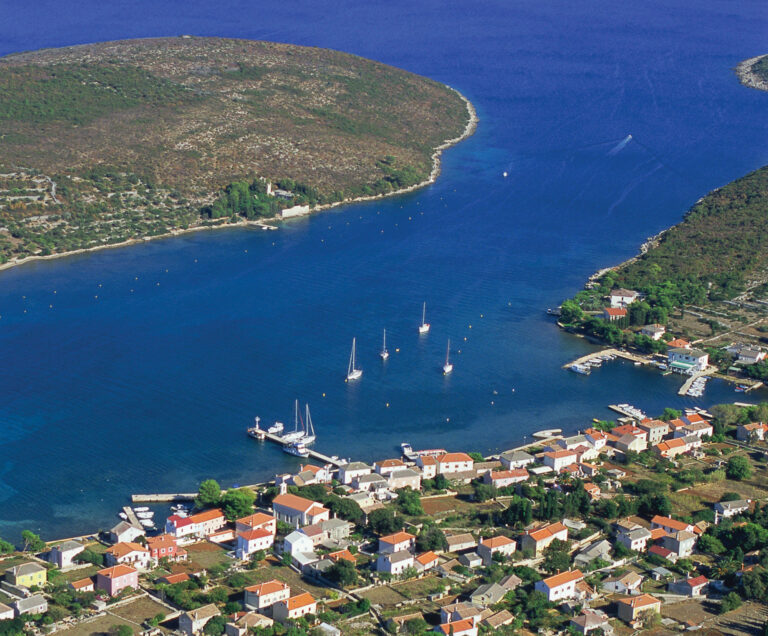
The easiest way to get to Kolan is from Šimuni, the only place on the island with a marina. It belongs to ACI, with 20 berths, and only privately owned boats are moored there. It stretches across the northwestern part of the large, well-protected natural bay. Although the nearby settlement has grown quite a bit in recent years, the marina offers tranquil surroundings and an environment completely different from Novalja. Although a little off the main nautical routes, it has beautiful waters in front of it.
There is a restaurant in the marina, several in the village, and certainly, the best is Didova kuća, owned by Gordana and Kristijan Fabijanić, direct descendants of the family that first settled in Šimuni. The restaurant is known for its good and varied authentic Pag food, including the distinctive ambiance and homemade dishes.
Only 2.5 miles away from Šimuni is the island of Maun, Škarda is only a little further, and the beautiful coves of Oliba are 10 to 12 miles away by boat. A 13-mile-long wake behind the stern will get you to Silba. Continue further along the southern coast of the island, anchor in front of Košljun or in Povljana because finding a place to moor there would be hard, or venture into the bays of Povljana and Dinjiška on the eastern arm of the island.
Through the Strait of Pag
Whether sailing into the Pag Bay from either the east or west, you will have to sail along the rugged coastline, swept by the bura. When the wind picks up at a decent strength, the Velebit Channel is not a sea to take lightly. Apart from a small section of the Žigljen port and the already-mentioned bay of Stara Novalja, there is no place to take refuge. So, if the weather conditions are unfavorable, you should avoid sailing here.
When Aeolus allows it, you will feel both the harshness and beauty of the coast. It becomes clear why Pag is called the moon island. The barrenness, the lonely beaches as well as the blueness of the sea, merge into an unprecedented yet uniquely calming scene. To remind us amidst the gusts of the bura, while the sea is smoking and the waves smash the shore with great force, how helpless we are before nature.
Entrance to the Bay
The mile-and-a-half long and half-a-mile wide Strait of Pag (in Croatian, Paška vrata) is the entrance to the expansive bay, providing refuge to those at sea during the bura, protecting them from its fiercest gusts. There, everyone can take refuge and drop anchor under its northern shores or dock on the Pag waterfront promenade. When you pass through them in good weather, you can anchor in front of a beach, setting out and leaving aside the charming settlements of Metajna, Zubovići, Kustići and Vidalići all the way to Caska and the western foreshore of the bay, anchor in front of Zrće, surrendering to the rhythm of the local entertainment. That is what most large yachts, often fifty meters long, do when they sail through the Strait of Pag.
Town of Pag
In Pag, you may find a berth on the local waterfront promenade or along the small breakwater of the former ferry port or anchor.
Inhabited in the time of the Illyrians during the Roman rule, it then received a saltwork, the feature that defines it to this day. In the middle of the 15th century the construction of a new town of stunning urbanism and beauty started. Under the guidance of famous urban planners and builders of the time (some say Juraj Dalmatinac was among them), the town was carefully planned with a network of regular streets that intersect at right angles and encompass a central square. All of which took place in a typical Renaissance harmony within the walls and towers. It was the poor strategic position of the former town of Pag, located on the opposite side of the bay, that prompted the decision to construct a new town.
Proportional and restrained beauty
You cannot disembark on the Pag waterfront promenade, stroll through its streets, sit in the square, enter the Church of the Assumption of Mary or the Benedictine monastery, or buy the famous baškotini without thinking about how much our current era, dominated by machines and ruthless builders, with a few honorable exceptions, has set us back and distanced us from this beauty, characterized by proportionality and restraint. So take the time to immerse yourself in a town that is still calm today and fully enjoy its charm.
Explore the saltworks, join their “Mornings in the Salt Fields” program and learn at the Salt Museum all about the hard work that it once took to get these white crystals to our tables, stored in the old salt warehouses. Be sure to visit the Lace Museum on the main square. You will learn all about this important aspect of the town’s identity. Where, even in this day and age, when everything we desire comes from China, a lace school exists, along with 200 women and a man in the town who have completed the course. Many “sew” lace at home.
If you long for the comfort of sitting and dining, enjoying coffee on the main square beneath the shadow of the church while taking a beautiful view is simply better than elsewhere, and you will dine well in the restaurant Na Tale and the taverns Bodulo and Bile, while not paying too much. And after experiencing all this, sail out to one of the beaches in the bay and immerse yourself in the sea and sun. Pag is definitely a different world.
Must-Visit Places
Historical Landmarks
Church of the Assumption of Mary
Benedictine Monastery
Salt Museum
Lace Museum
Cultural Events
International Lace Festival
Pag Cultural Summer
Experiences Worth Having
Tovarnele Olive Presentation Center
Tasting at MIH or Gligora Cheese Factory
Mornings in the Salt Fields Program
Restaurants and Taverns
Palma
Pod zvon
Boškinac
Didova kuća
Na Tale
Bodulo
Bile
Clubs and Bars
Kalypso
Zrće