

A sailor will instinctively describe Lošinj as remarkable. It is diverse; its towns are well-planned, steeped in history and maritime tradition, and have preserved their character. When you arrive there by boat and tie up along one of the quays, you immediately sense that this island– and many of our friends are part of it – truly lives for its places, striving to preserve the spirit that made us fall in love with them in the first place. Nerezine, the Apoxyomenos Museum, the Blue World Institute, cycling trails, Losinava, regattas, gastronomy, events – none of these exist by chance. And yet, the island remains unspoilt. Its entire northern and north-western coast is wild and untouched, almost as it was before human presence, dominated by Osoršćica Ridge towering above. The same is true of the southern shores.
For those who sail, Lošinj is a truly welcoming island. From the deep bay of Mali Lošinj and the unique charm of Veli Lošinj, to Nerezine, the anchorage beneath Osor, and a string of picturesque coves along the southern coast, the island offers a harbour for every taste. It’s easy to see why the first glimpse of Lošinj brings a smile to the faces of those approaching from the Gulf of Trieste, the Venetian Lagoon, or the Istrian coast.
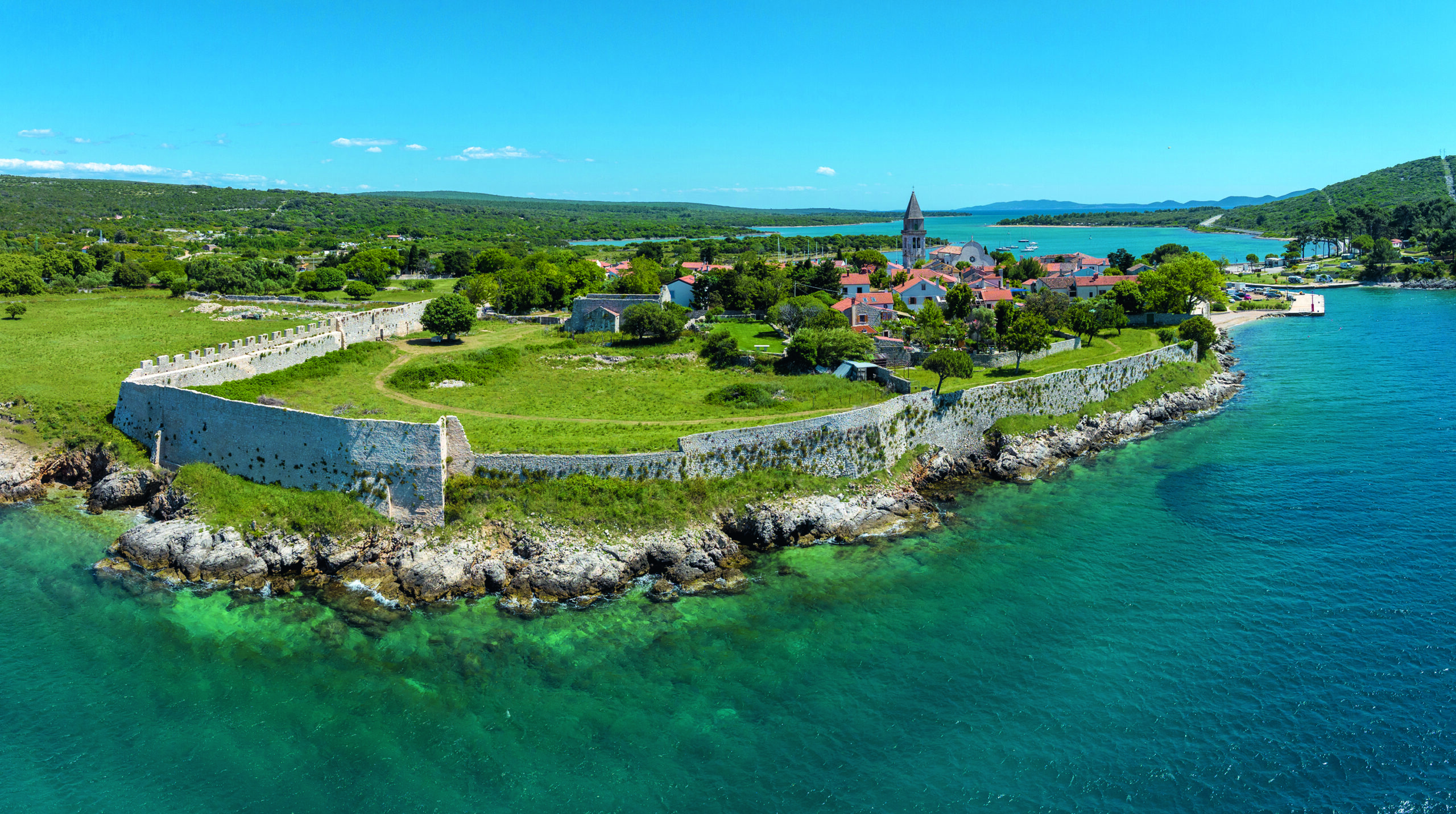
Osor
A small town with a great history – founded on the most important waterway connecting the waters of Kvarner and Kvarnerić.
Although most sailors traditionally choose to stop in Mali Lošinj for all that it offers, we head first to Osor. A charming, small town whose origins date back to ancient times, was built alongside the Kavuada Passage, twelve metres wide and 120 metres long, linking the waters of Kvarner and Kvarnerić. A passage that existed here already in Roman times – and according to some research even earlier, during Illyrian times, albeit in a different location – proved crucial for Osor’s importance and development. When it came under Roman rule in 167 BC, it was fortified and became a crossroads of maritime routes linking Italian ports of the northern Adriatic with the central Adriatic and onwards to Greece. After the fall of the Western Roman Empire, Osor gradually lost its prominence but remained an important maritime point until the 15th century and the arrival of Venice. Venetian ships, able to sail closer to the wind, diverted the main sea routes west of Lošinj, and Osor gradually fell into oblivion.
The drawbridge opens twice a day, at 9 a.m. and 5 p.m., primarily to allow yachts and local boats to pass beneath it. But even if you have arrived merely to transit the channel, consider staying and devoting at least a day to Osor. You will not regret it. Pick up one of the mooring buoys south of the channel or anchor in the bays of Skaline or Bijar to the north. Hop into the dinghy and head for the quay.
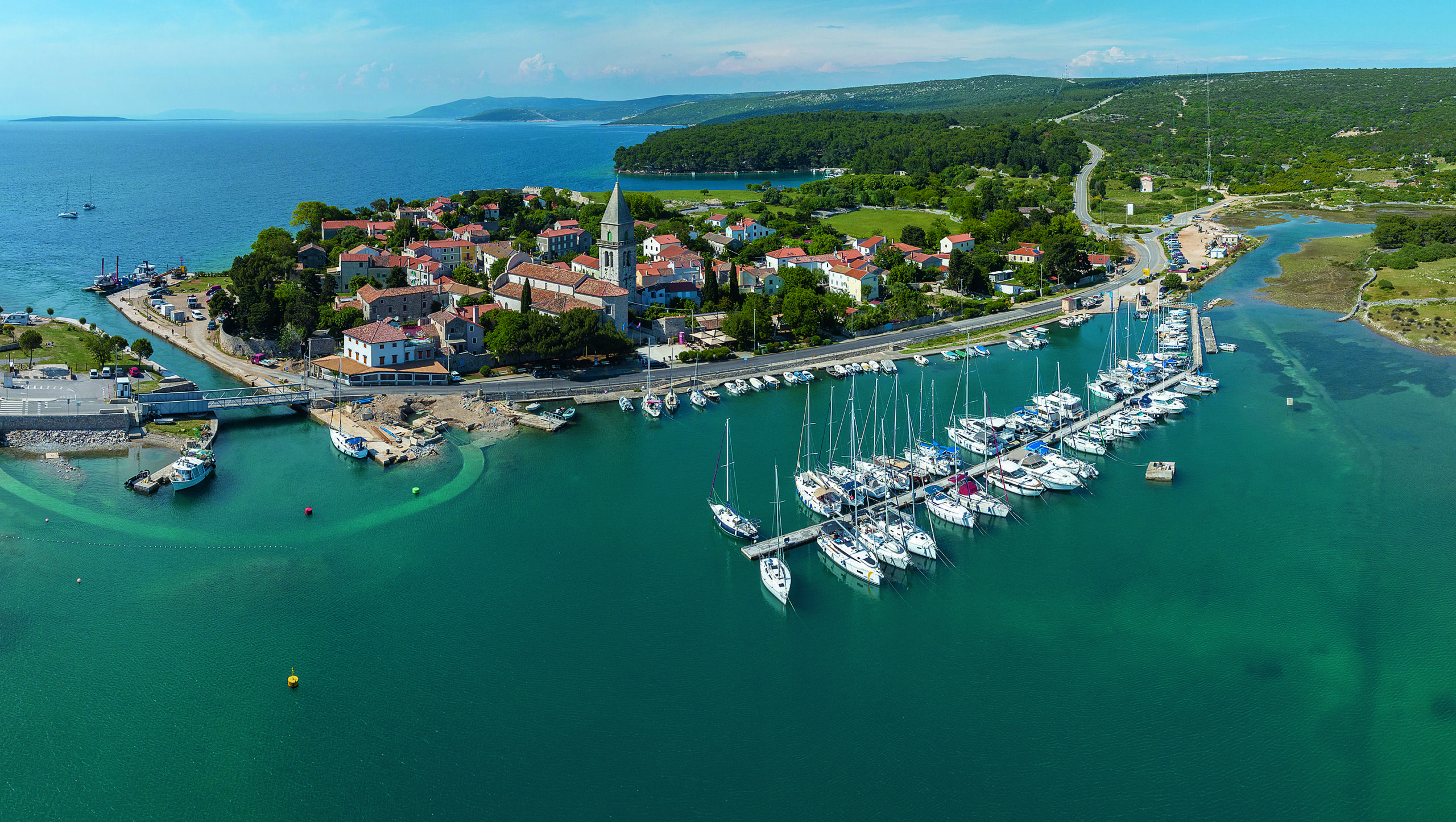
In winter, Osor counts no more than forty permanent residents; in summer, the number increases noticeably, and afternoons and evenings are pleasantly lively. The town is exceptionally well-designed and rich in historical remains – from its ancient city walls to the early Christian basilica. The central square, framed by buildings from the 16th and 17th centuries, the town hall and the bishop’s palace housing a sacral museum, is particularly attractive. Adjacent stands the Cathedral of the Assumption of Mary, home to valuable paintings by Palma il Giovane. Osor also provides an ideal stage for the Osor Musical Evenings, a renowned classical music festival held from late July through most of August, celebrating Croatian musical heritage and creativity.


After indulging in art and history, a few welcoming places offer refreshment. This spring, we chose Konoba Mare, run by former television journalist Mirjana Hrga, who radically changed her life five years ago. Whether or not she had much culinary experience before is irrelevant—she clearly knew what she wanted: a tavern where she and her guests could gather, eat well, and enjoy good company over typical Kvarner and Istrian dishes. We lingered over a glass of wine, an excellent black cuttlefish risotto, and Mare’s salad with goat’s cheese, dried and fresh fruit, sage honey, and roasted hazelnuts.
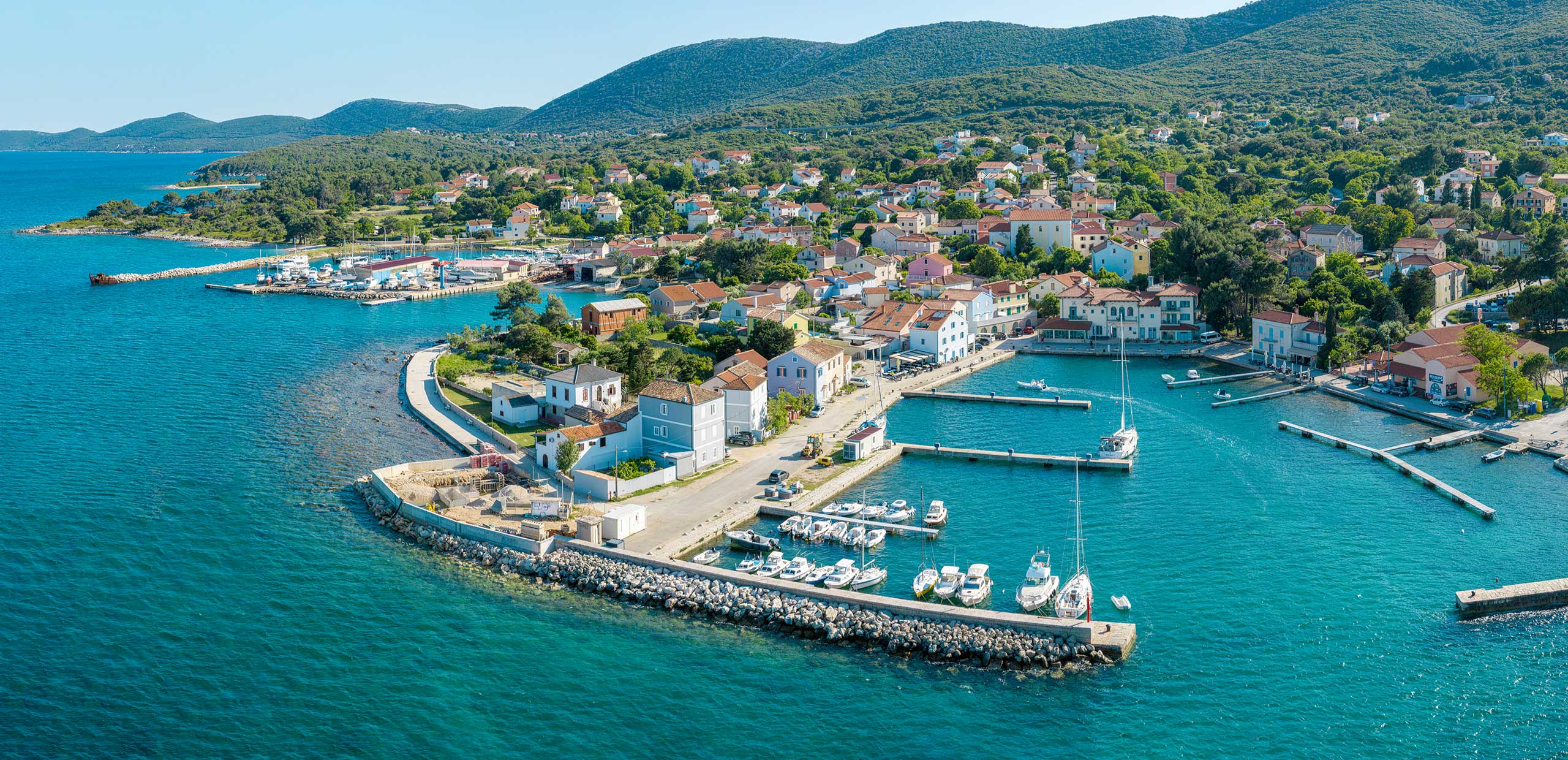
Nerezine
Those who leave their boat at the Nerezine dock and climb Televrin, the highest peak of Osoršćica, are rewarded with a view over the entire Lošinj Archipelago
From Osor we could sail north along the island’s northern and western shores all the way to the entrance of Mali Lošinj harbour. That route would take us past the two-mile-wide northern headland and several small coves, always keeping an eye on the bura. A cardinal mark off Cape Osor indicates that once rounded, the course leads along the western coast of Lošinj. Instead, we choose Nerezine, a village of shipbuilders and seafarers.
Those arriving by boat will seek a berth in the main harbour, along the breakwater and two piers on the southern side, managed by the port authority. Around thirty well-protected berths are equipped with moorings, water and electricity. A fuel station lies just north of the harbour, meaning that sailors can find everything they need in this small place. In the neighbouring bay of Biskupija, there is a shipyard and berths for locals.
Although moored right in the centre, you will not be disturbed by noise or crowds. Time can be spent strolling through the village, visiting the Franciscan monastery and the Church of St. Francis, home to several interesting paintings, climbing to the ruins of the fort above the village, or dining in one of the local taverns.
Those with a taste for hiking have an exciting opportunity: a trail leads from the village to Televrin, the 589-metre-high peak of Osoršćica Ridge. The climb takes two and a half to three hours, but you will be rewarded with a breathtaking panoramic view of the Lošinj archipelago—and on a clear day, the islands and coastlines of Istria, Kvarnerić, Velebit, Rab, Pag, and Silba appear as if laid out on the palm of your hand.
Continuing north, the trail reaches the Osoršćica mountain hut, open on weekends and run by local mountaineers, before descending back to Nerezine via the Osor side.We left Osoršćica for another time, perhaps because that evening the Festival of Mih was taking place on the main square just above the quay.
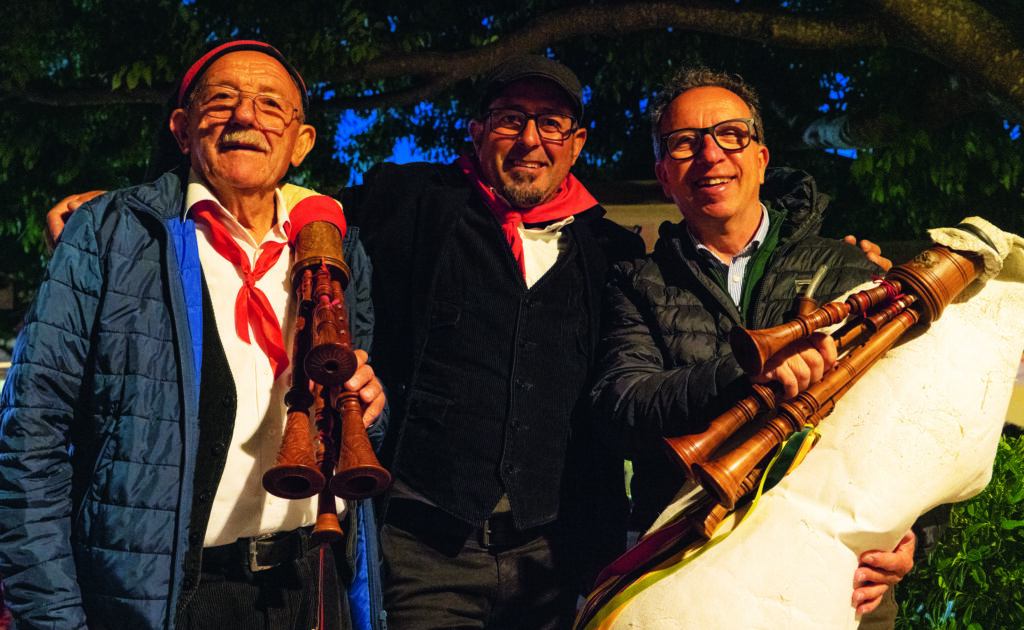
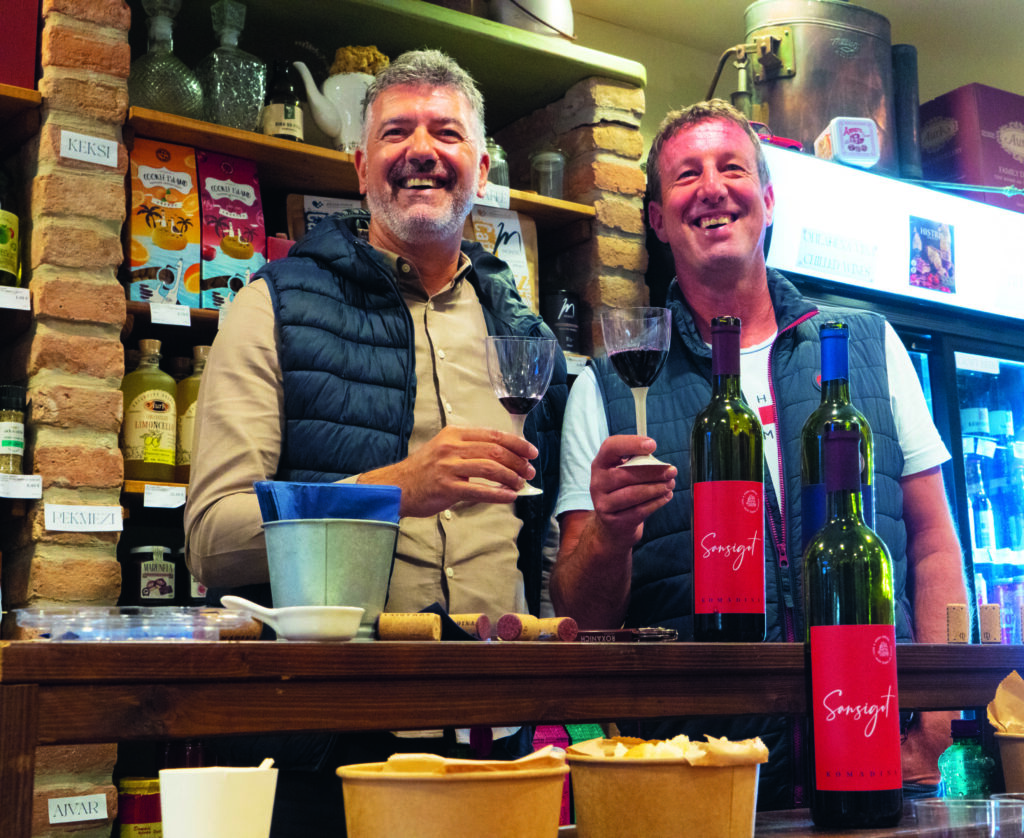
Bagpipers from several European countries filled the narrow streets with sound – at moments so rich it brought McCartney’s Mull of Kintyre to mind. The musicians themselves were far from famous, enthusiastic amateurs from Taormina in Sicily, brimming with positive energy. We also met Marko Komadina, a Lošinj winemaker with vineyards on Cres at Punta Križa, and tasted his Sansigot and Syrah – the first fresh and ideal for summer evenings, the second full of intoxicating fruit flavours. Nerezine is also an opportunity for yet another encounter with Ferdinand Zorović, a man of exceptional merit in preserving the village’s maritime heritage, today most visibly embodied in the restoration of the logger Nerezinac and the Nerezine Regatta of traditional boats.
Along the Eastern Coast
The most important nautical toponym of this stretch of the Lošinj coast is the Privlaka Passage
Sailing south from Nerezine for the next seven miles to the passage of Privlaka which, from this side, gives access to Mali Lošinj harbour – the coastline becomes less indented. The only coves of moderate nautical significance are the coves of Sveti Jakov, Lučica and Poljana: fine for a swim, but not for longer stays. The bridge opens twice daily, at 9 a.m. and 6 p.m., remaining open for an hour, with priority given to vessels leaving the harbour. Next comes Sveti Martin harbour, the northern harbour of Lošinj, but finding a berth there can be difficult, as it is crowded with locals and their boats.
If you want to go swimming, you can jump in from the boat in the neighbouring bay of Baldarka. Here, you can anchor safely in all conditions except during the bura. The bay is surrounded by dense pine forest and dotted with a few houses, a holiday resort, and a small pier where a dozen fishing boats are moored. If you haven’t visited Mali Lošinj yet, it is only a fifteen-minute, easy walk away.

Veli Lošinj
Veli Lošinj has always had its charm: nestled close to the bay, surrounded by the captain’s houses and the villas of the Lošinj shipowners — flanked by the residence of Archduke Carl of Austria
If you get a chance to enter and find a berth in Veli Lošinj, take it. Here as well, the main hazard is the bura and in such conditions, don›t even try to find a berth. For sailors in transit, there are only around ten berths available along the quay beneath the church or on the outer side of the small pier protecting the small local harbour. The boats are packed so tightly, you could almost cross the harbour by hopping from one to the next– and it is precisely this that lends extra charm to the village, nestled in a bay surrounded by captains’ villas and the former residence of Archduke Karl Habsburg, later converted into a hospital. Veli Lošinj has managed to preserve its tranquillity, and it is a place where one can truly unwind. Walk around the headlands, climb the narrow streets, and admire the captains’ and patrician villas with gardens full of exotic plants. Step into the Baroque Church of St. Anthony the Hermit (Sveti Opat Pustinjak) to see its rich collection of Italian master paintings, or continue uphill toward Velo Selo.
Veli Lošinj is also home to the Blue World Institute (Plavi svijet), dedicated to marine research and protection, particularly of dolphins and turtles. Its educational centre is located on the waterfront. Founded by Italian Giovanni Bearzi and continued by local experts, the institute not only cares for these animals but actively promotes awareness of the need to preserve their habitat. Do not miss a visit.
There are three restaurants right by the sea; we generally enjoy a hearty meal at Ribarska Koliba at the end of the wharf.

Our favourite spot in this part of the island, however, lies in the neighbouring bay. In the morning, before sailing, do not miss the opportunity to visit the little fish market on the western coast of the waterfront after you see that some of the local fishermen have begun to unload their catches. This is where you can purchase good and freshly caught fish at fairly reasonable prices and prepare a superb lunch or dinner at your next stop.

Rovenska
In this charming former fishing harbour, sailors are drawn especially to one of the island’s most famous restaurants

Less than a mile further is Rovenska, a fishing harbour recognisable from afar by its 200-metre-long breakwater that protects it from the bura and along which you cannot moor. There are, however, berths for visiting boats. A few years ago, concrete piers and a smaller breakwater were added along the southern shore, and the main pier was extended, equipped with moorings, electricity and water. Along its outer – and occasionally inner – side, there is space for sailors.
The harbour itself is lovely, with a fine sandy beach nearby and one of the Adriatic’s best restaurants, Bora Bar, run by Marco Sasso and Maja Balenović. Known for its signature cuisine, full of inspired dishes featuring pasta, mushrooms, and a variety of seafood, it once again lived up to its reputation on our visit.
From Rovenska we continue towards Cape Kurila, the southernmost point of Lošinj. Along the way, there are several coves, all exposed to the bura. Far more compelling are the two uninhabited islets of Mali and Veli Orjule on the port side. In the waters off Veli Orjule, a bronze statue of Apoxyomenos from the 1st or 2nd century BC was discovered in 1996 and raised three years later. Presumably thrown overboard from a merchant ship during a storm, it is one of the most complete and best preserved examples of this type of ancient sculpture. Today it is displayed in the Apoxyomenos Museum in the Kvarner Palace on Mali Lošinj. In summer, many boats anchor around the Orjule islets, mostly for swimming.


The Most Beautiful Coves of Lošinj
Lošinj’s most beautiful coves stretch along the southwestern coast. First comes Plijeski, then Balvanida, followed by Krivica — famous from tourism posters — and finally the large cove of Čikat
Sailing along the western coast brings us to Lošinj’s most beautiful coves. First comes Plijeski, with its lovely sandy beach, followed by Balvanida, a fine and reliable shelter often used by excursion boats. Should you stop here, you will not regret it. The bay cuts deep into the land and curves eastwards; its steep shores are covered with pine forest and maquis, and the sea is clean and clear. At the very base of the cove are a beach and a small pier for mooring your dinghy, should you wish to walk a few minutes to the Balvanida tavern, where island lamb and kid are served alongside freshly caught fish.

Krivica, our next stop, is well known from tourist posters. Boats lie moored beneath the pines in a bay shaped, fittingly, like an S. Its innermost section is well protected, further sheltered by pines descending almost to the water. During the day, it is crowded with boats full of swimmers; in the evening, only yachts intending to spend the night remain—though these can still number several dozen. The bay is under concession, with about ten mooring buoys along the northern shore; others may anchor and take lines ashore.
Before reaching the entrance to Mali Lošinj harbour, there are several remaining coves: Sunfami, Veli Žal, and the large bay of Čikat.
Along its shores stand Lošinj’s most luxurious hotels and villas. The bay is excellently protected, but anchoring is prohibited. Mooring is possible at a large concrete pier and a smaller floating pontoon, but only with the permission of the hotel management holding the concession. One final stop before Mali Lošinj is the islet of Koludarac, which provides sheltered anchorage.

Mali Lošinj
In the 18th and 19th centuries Mali Lošinj was one of the Adriatic’s most important maritime centres. Today, it offers sailors the lively atmosphere of an island town
By Adriatic island standards, Mali Lošinj is a relatively large town. It is visible from afar as you enter its almost three-mile-long harbour. Civic houses on both sides, a long and well-kept waterfront stretches ahead, ending in a broad square. In the 18th and 19th centuries, Mali Lošinj was one of the Adriatic’s most important maritime centres. Today, it offers sailors the lively atmosphere of an island town, as well as berths in the marina on the northeastern shore, at the very end of the harbour, and along the waterfront.
Entering the spacious bay, you can choose between the marina on the north-eastern shore, berths for yachts along the Riva of Lošinj Captains, and four pontoons at the very end of the harbour. Although many more berths exist, particularly along the northern shore, these are reserved for local boat owners, excursion vessels and ferries. Two large waterfronts – Vela and Nova – serve local lines and international traffic. Vela Riva is currently under reconstruction and will return to full operation in May 2026.
Choosing the pontoons on the south-western shore, equipped with moorings, electricity, water, and sanitary facilities, places you right in the heart of town life. The largest pontoon, 80 metres long and four metres wide, also acts as a breakwater, significantly reducing wave action caused by the bura, tramontana, and lebić. It is worth noting that there are two fuel stations for boats within the harbour, making refuelling generally quicker here than elsewhere.


Those seeking more peace will opt for the newer section of the marina on the north-eastern shore, alongside a long new waterfront accommodating yachts up to 30 metres. The marina features a pleasant café and restaurant, while its older section provides berths ashore and in a hangar. Several service workshops are located here, along with a shipyard immediately adjacent.
Mali Lošinj was founded in the 12th century by Croatian families migrating from Osor. By the mid-18th century it gained importance, becoming the island’s centre and a significant maritime hub in this part of the Adriatic. The golden age of Lošinj shipping and shipbuilding came in the 19th century, when local owners possessed some 150 sailing ships and over twenty shipyards operated in the harbour. A state nautical school opened in 1855. Although the advent of steamships led to a decline in maritime importance, many Lošinj families remained at sea. The many excellent sailors coming from the island testify to the preservation of tradition and the transfer of knowledge from Lošinj captains to subsequent generations. Today, instead of sailing ships, the harbour is occupied by yachts and pleasure boats.

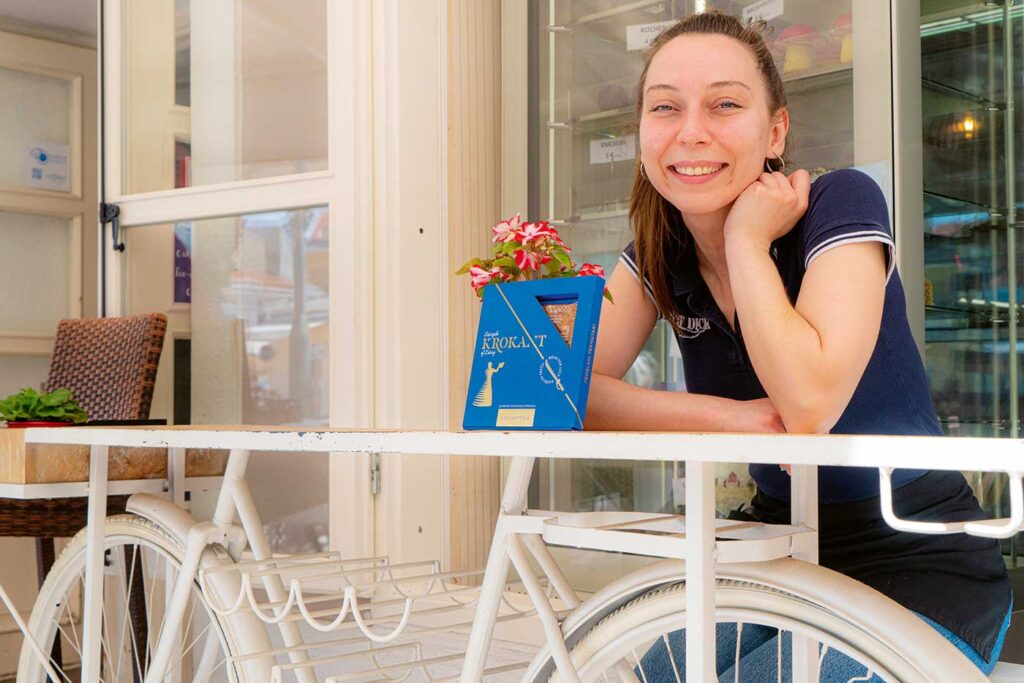
In this charming island town, sailors feel comfortable and always have plenty to do. Gourmets will find satisfaction in several restaurants – we recommend Corrado – serving fresh fish, renowned Kvarner scampi and excellent island lamb. Breakfast Club, a project by Martina Perić and her husband, offers healthy, locally based breakfasts and light lunches, along with fresh juices and creative dishes, delivered even to yachts anchored in nearby coves. The fish market offers good daily catches, and the market is well stocked with island produce. Cafés abound, but for a truly local experience, coffee and cake at Moby Dick pastry shop on the main square are a must. Its owner, Petar Goleš, recently entered the Guinness Book of Records by creating a 14-tiered crocant, 2.72 metres high—later ceremonially broken with a sabre. You can still buy Crocantessa, a sweet edible souvenir, at Moby Dick.

Spend the rest of your time strolling through town and along the beautiful seaside promenade. Lošinj is an island made for cycling, with numerous trails that should not be missed. Essential stops include the Apoxyomenos Museum and the restored logger Nerezinac. The museum offers not only the impressive statue but also insight into the complex process of its recovery and restoration, while the Nerezinac allows visitors to experience Lošinj’s maritime tradition in situ.
Artaturi
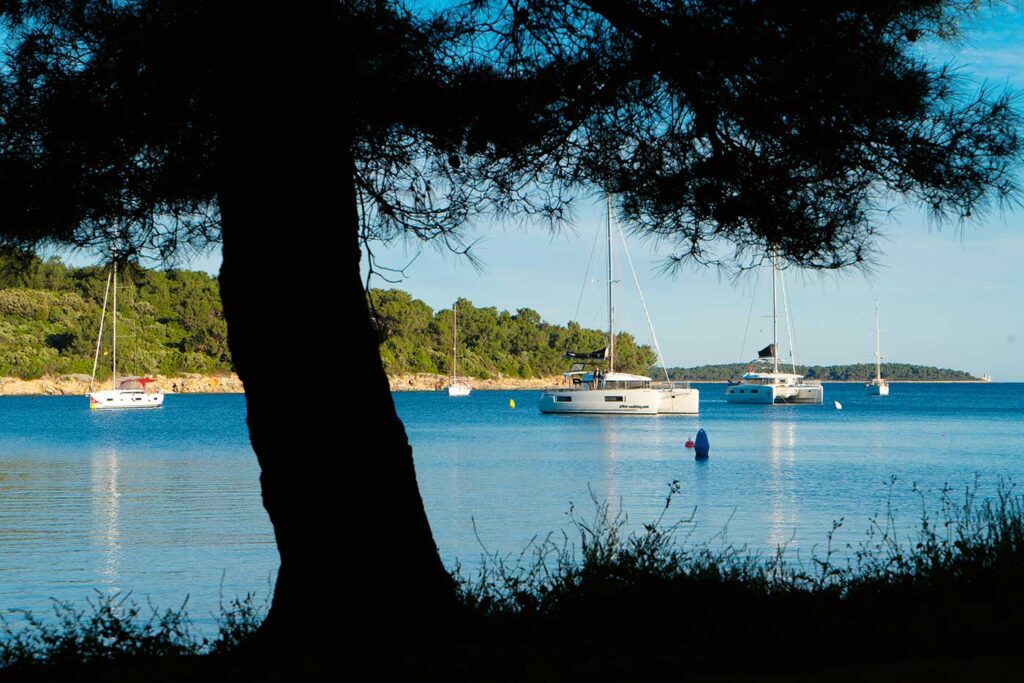
Artaturi Bay, a well-known safe anchorage, is sheltered from all winds except the Sirocco, with the exception of its western side cove
Leaving or approaching Mali Lošinj harbour, you can anchor in the spacious bay of Artaturi, indented into the land northwest of Bocca Vera, the harbour entrance. This large bay, with several arms, offers excellent shelter from the tramontana and summer storms and lies just three and a half miles from Mali Lošinj’s waterfront. Anchoring is possible, as is picking up one of around ten mooring buoys. The only caution is the southerly wind, to which the bay is open except for its westernmost arm—in such conditions, it is best to leave. Numerous houses line the deeply indented arms, concealed by dense forest, each with its own small pier. Slightly inland stands the well-known family restaurant Artatore Janja.

From here, to complete a roughly 45-mile circuit around the island, we sail past the small coves of Zabodarski and Vela Tizna, with their fine beaches, round the broad Kurila headland, and continue along a less indented coast. Apart from Liski Bay, suitable for anchoring, the remaining coves are better for day stops and swimming than for secure shelter in windy conditions, especially during the bora or westerlies. When weather allows, we usually choose Tomožina. Eight miles of sailing along a rugged, steep coast separate us from the cardinal mark off Cape Osor, where the circle around the island is complete.