
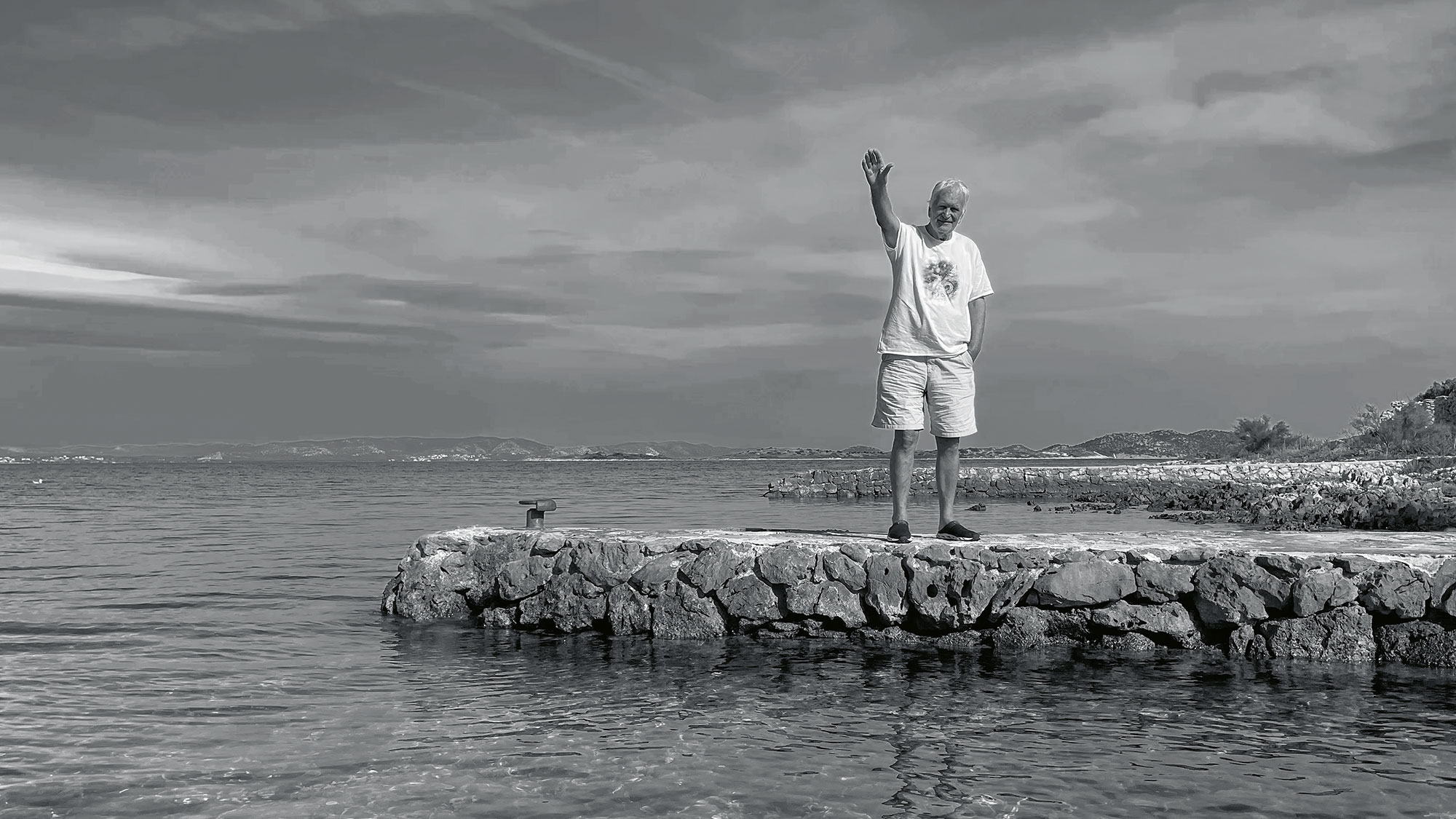
At a time when Croatia’s coastal landscape, its value and its devastation are being discussed more intensely than ever, a conversation with Nikola Bašić is inevitable. An architect with a distinctive signature and an extensive oeuvre, whose creations enrich the Croatian coast and often embody a new symbolism of his own, he continues to create even in his eighties.
We visited the Murter-born architect and citizen of Zadar on the islet of Gangarol, where he built a small house on his family estate, a place where he can rest and reconnect with his roots. The island originally belonged to two Murter families, the Jurans and the Bašićs. Nikola’s grandfather and his two brothers married three Juran sisters in what might be called a package deal. That was how the little island was kept safe from intruders.
When you leave the anchored boat in a dinghy and reach the little pier beneath the tamarisk growing beside the entrance to the Bašić courtyard, it becomes clear that you have arrived at one of the places that shaped his architecture. His architectural oeuvre encompasses a series of remarkable and distinctive projects. Few architects can boast works such as the Sea Organ, the Greeting to the Sun, the Church of Our Lady of Carmel on Okit and the memorial to the firefighters who lost their lives on Kornat, and a succession of other projects. He is an honorary doctor, an academician and the recipient of distinctions from every quarter.


You must be a contented man?
Judging by the way others perceive me, one might indeed say that I ought to be content and happy. Above all, grateful. Only a grateful man can be truly happy. This may sound sentimental, but I am convinced that in architecture I am merely a medium. The ideas that stirred and inspired me at certain moments were given to me.
Sometimes I ask myself whether it was I who conceived the crosses on Kornat, a seminal work in my artistic practice. My answer is no. They came from somewhere deep within me. That is intuition preceding illumination. I believe that a rational approach has prevailed in art today. Everything is philosophised and conceptualised, while the intuitive component has been completely suppressed. That is profoundly wrong. An artist need not know why something was done, nor must it be explained.
The other day, a young colleague sent me a recording of the final lecture delivered in 1986 at the Faculty of Architecture in Belgrade by Professor Bogdan Bogdanović, an architect, philosopher, artist and dissident under Milošević. He spoke of architecture as gnosis, a quest for knowledge through drawing by hand, to which he attributed mythical qualities because it is the product of what Heidegger called “the thinking hand”.
That hand is guided not only by our will, but also by mental processes that eventually produce a result whose final form even we could not have foreseen. This is identical to my own experience. You think with your hand. Your fingers, the tactile contact between paper and pencil, and the process of thought become one. It is a path guided by an intuition you cannot control.
And today, how and with what do architects think and feel?
Today architects have a keyboard and a screen. It is a digital, exact tool. There are no nuances and no surprises. To understand the difference between drawing by hand and drawing digitally, consider an analogue and a digital clock. Imagine that only the full hours are marked on the analogue dial, and then imagine that the digital version of the same clock also displays only twelve numbers.
When we look at an analogue clock, we can estimate the time between the numbers, even when the hands are somewhere in between. We see and feel that time, listen to its ticking and sense its passage. A digital clock has no hands, so there is nothing between one number and the next. It is a blind interval, a silent caesura, time that does not exist. The digital world is defined by two digits, 0 and 1. Nothing exists between them. In the same way, there is nothing between two keys on a keyboard, neither space nor time.
You created much of your oeuvre in spatial or urban situations that could be highly complex. Conditions were not always favourable, and you often had to confront them…
Difficult and unsuitable situations provide an extraordinarily powerful stimulus for a creative response. The more complex the problem, the stronger and more engaged the creative answer it demands. When you have an ideal, level plot where everything is in order and everything works in your favour, you are at a disadvantage from the outset. If nothing troubles or challenges you, there will be no authentic solution. Ideas are born under pressure.
And that is how true architecture comes into being…
All manner of things are built, but there is very little true architecture. It is not difficult to make a house or construct a building. The fundamental question is what constitutes architecture and what is merely construction. At what point does a building acquire the qualities of an architectural creation or a work of art?
In my view, a work of architecture is a useful building that also seeks to say, convey or represent something, one that possesses a symbolic dimension. We must ask what our architecture ought to say at a time when we have become estranged from our own character and identity. It ought to bear witness to our culture.
I have devoted my entire life to architecture, and I can now say that I have come to understand it as a medium of communication through which I wish to advance my own culture, the culture belonging to this landscape and this community. When I achieve that, I consider it the greatest possible accomplishment. It need not be a spectacular work, use cutting-edge technology or follow the latest design trend. It must simply be authentic architecture.
Just as you use your medium, the written word and the image, to promote our maritime culture, so our architectural and urban culture must be expressed through building, stone and concrete.
That can hardly be an easy task. How do you accomplish it?
I always tell my younger colleagues and students to ask themselves what they have achieved if they build a house that could stand anywhere in the world. If the house does not clearly express its belonging to a particular landscape and local culture, it cannot possess universal value either.
Instead of pursuing originality, many architects resort to cheap imports. Now that everything in this country is subject to importation, why not import architecture as well? We import Swiss chard, garlic and onions into Dalmatia, along with as much as 80 % of the salt we consume. Agrokor, it is said, even sold salt from the Maghreb in packaging that declared it to be Pag salt after acquiring the Pag saltworks, just as its owner walked around in patent-leather shoes made from genuine home-grown crocodile skin.
As it is with salt, so it is with architecture. Why make the effort to be original when everything has supposedly already been invented and can simply be repackaged and resold? Young people scroll through Pinterest and are left helpless. Is there anything that cannot be found there? Of course there is, plenty of it. You simply have to know how to look around you.
When I came to Kornat after the tragedy, I too simply looked around me. What I found there cannot be found on Pinterest. Twenty sculptors and two architects were invited to enter the competition for the memorial. I won by a single vote. That decisive vote was cast by the late Tonko Maroević. Today everyone says they cannot imagine any other memorial in that place.
Does that explain why ordinary people with no formal education once built so harmoniously, because they looked around them?
I would not say it resulted from that kind of conscious awareness. When you look at all those organic settings, particularly our extraordinary cultural landscape and its harmony, where you cannot tell where nature ends and human intervention begins, you ask yourself where that harmony comes from.
It comes from building by hand. Now that the machine has arrived, it is all over. Bulldozerism has replaced urbanism. When you have an enterprising mayor and a powerful excavator, no obstacles remain. People once spent years carving out a little path. Today it is done over a weekend, while the inspectors sleep.
Yet your dry-stone crosses also revealed how few master craftsmen still know how to build them.
Something disappears every day. Languages vanish, and so do knowledge and skills. The tragedy is that this is intangible heritage. Artefacts can be reconstructed and old structures can always be restored. But when a person dies, the last person who possesses a particular skill, that knowledge is lost forever.
Our landscape and cultural heritage are the greatest treasures we possess, yet we are destroying them everywhere, from the largest cities to the last cove in the Kornati islands or on Hvar. The pressure from investors is enormous. In an impoverished Croatia, many people want to take something, to build…
It is a painful question that breeds bitterness. I do not like bitter people. I find the hopelessness that has overtaken our people and our community deeply depressing. That state is unnatural, as though it were being deliberately generated by some sinister force.
But when we speak about what troubles me most professionally, which is the landscape itself, I cannot help but feel bitter. I cannot overcome that bitterness because I see that we have gone too far. We depend on tourism, which inherently generates construction, and now it has been joined by the current property fever, fuelled by the crises of disease and war, during which people seek the safest form of investment. The result is an overlapping of demand. We must ask how we can resist it, how we can save our landscape and manage it wisely.
Can you see an answer to that question?
For a long time, I believed there was not yet sufficient awareness of the threat hanging over our landscape, but I am now convinced that this is not true. There is no one you can speak to who is unaware that unacceptable things are happening in our surroundings, things that threaten the future of our country.
That awareness exists in political circles too, but there the subject is taboo. Why is there no political discussion about space, our most precious asset? Because we have become dependent on the very thing that distorts it most, and that is tourism. This is compounded by a global trend towards coastal areas.
We are trapped in this situation. We have no alternative, and all of us are compelled to participate in it. It is the syndrome of an addict or a smoker who knows the harm caused by an addiction but cannot resist it. There is neither the collective will nor the strength to oppose the situation because we are all part of it. Every one of my clients comes from that milieu. They either come from tourism or their property investments depend on tourism. By the very nature of my profession, I too participate in the process I am speaking against.
But if there is a spatial plan, both the investor and the architect must abide by it.
There is no genuine spatial planning in Croatia. Today, plans serve to interpret current interests. They have become tools through which the constellation of interests prevailing at a given moment is imposed upon the landscape. And all this is absolved by democratic procedure. Such plans are a quasi-democratic farce that determines who will get there first, who will move faster, who will build here and who will build there. Plans have become a crossword puzzle of competing interests, containing no thought about space and no guiding idea. That cannot be called planning.
Plans once had preliminary studies. No plan was drawn up before the demographic and environmental circumstances, social and economic characteristics, soil, water and transport had first been studied. A synthesis followed.
Today, plans contain none of this. They have been reduced to bare implementation rules. They begin immediately with Article 1, Article 2 and Article X, and you soon realise that one article is for Petar, the next for Pavle and the third for Šime. In the end, it is democratically voted through and enacted as a law applying to everyone.
Is there a political vision for Croatia’s coastal landscape, for its protection and development?
There is no political vision for either the coast or Croatia’s territory as a whole. There are, in fact, the so-called strategies for this or that form of development, in which the honeyed vocabulary of socialist self-management has now been replaced by Brussels metalanguage, that mantra-like phraseology of mediocrity that makes my hair stand on end.
I recently learned from reliable sources that we have 326 documents dealing, directly or indirectly, with strategies for Croatia’s territory. I maintain that this is precisely the proof that we possess no clearly articulated or recognisable vision, let alone an authentic one.
Moreover, all these strategies, whatever their merits, stand in stark contrast to legislative practice. The laws themselves are mutually and paradoxically contradictory and, bastardised though they may be, ultimately remain unenforced.
The maritime domain, for example, Croatia’s most valuable and productive space, is “controlled” through several mutually incompatible laws. All of this creates a convenient legislative and regulatory substrate in which corruption can flourish throughout the entire hierarchy.
How can we resist this? How can we deal with it?
If you ask me, I advocate radical legislative deregulation. I do not mean the absence of rules and laws, but their restoration to an elementary form, like the Ten Commandments. Clear, precise and comprehensible to everyone.
If it were up to me, the first such commandment would be: build nothing in places where nature remains untouched. Why interfere with primary nature when so much cultivated landscape has already been abandoned?
In that way, the idea of our national territory could be given legal expression, provided such an idea exists or we can agree upon one. So far, I have never heard any such idea expressed in Croatian political life, much less heard it debated.
Until we reset both our ideas and our legislation, and until we apply the most advanced tools for spatial planning and control to ensure that our vision is implemented, no one will stop this linear carpet of concrete. Guided by cadastral boundaries as its only recognisable point of reference, it is devouring the entire coast.
How have other countries dealt with this, particularly our Mediterranean neighbours?
We used to mock the Spanish and Italians for what they had done to their coastlines, and now the same thing is happening here in an even worse form.
Fourteen years ago, I attended a scientific conference on tourism and spatial development in L’Escala, Spain. I was invited as the only foreign guest to explain how Croatia had achieved what they had been unable to accomplish. With enormous admiration, they asked how we had managed to create something like Zadar’s waterfront and preserve our coast.
I replied that I was flattered they saw us that way, but that our landscape too was under serious threat, and that we had an old saying used to describe such situations. A man learns from the experience of others, it says, while a donkey learns from his own. It is now clear that, in this story, we are the donkeys.
Is the devastation of the coastal landscape growing?
It is like a fire. Once it starts burning and you have no means of extinguishing it, it burns for as long as there is fuel. And we shall scorch our landscape. God gave it to us as our real and metaphorical oil. The oil is flowing in every direction, everyone is pumping it, and we merely watch. We live from that oil, of course, but in the most short-sighted and foolish way imaginable. The state collects VAT on tiles, beams and plasterboard, while the municipality receives its utility contributions. All of it is a one-off gain, while the landscape is lost forever.
Once you have taken something’s virginity, it can never be virgin again.
Here is a story. Some fifteen years ago, an elderly American came to see me accompanied by a local politician from Zadar. He intended to undertake extensive construction on the southern side of Pašman, and everything was going to be “in keeping with the style”. Croatia was a fantasy to him. Business was supposedly not his primary concern. He simply wanted to help develop the place, as it seemed a shame to leave something so beautiful untouched.
With due respect for his motives, I declined and explained that I did not regard it as development. It was untouched nature, whose intrinsic value exceeded anything he believed he could create there. On this planet, whose dimensions are fixed and which cannot be inflated like a balloon, primary space grows scarcer every day, and its value will therefore continue to rise.
He looked at me and said, “I understand you completely. I know what you mean, and I could not claim that you are wrong. But I have a question too. Why, then, does your spatial plan mark this untouched landscape with the letter T?”
I replied that he should ask the man who had brought him to me.
You designed two fundamentally different marinas, Zlatna Luka and Betina. The former is a fully-fledged nautical industry, while the latter is a small yacht club, albeit one forming part of a shipyard.
Zlatna Luka, the bay’s original place name, or Dalmacija as the marina is known today, was created within Zadar’s conurbation, in an area already affected by construction. I considered placing a marina on the peri-urban fringe a desirable extension of the city, expressed through nautical culture as an urban boating environment. It was created in the late 1980s, when we sensed that an era was approaching in which Croatian marinas would no longer provide permanent berths solely for foreign yachts, but would, like French counterparts, be filled predominantly by our own domestic fleet.
I believed that Zlatna Luka could become a nautical outpost of our capital. I was drawn to the idea of people from Zagreb having their own boating base at the gateway to the nearest Dalmatian archipelago. It made sense even before the motorway was built, and makes more sense still today. It was the first and largest nautical centre to incorporate elements of what is now promoted as the latest trend: the nautical cluster.
It was conceived as a large nautical harbour, but also as a place for urban leisure within a boating environment, rich in specialist retail, gastronomy and a wide variety of services, including residential and hotel accommodation.

Until the Turks took over D-Marin and gave it a new name, none of this port superstructure had been built. Like many Croatian marinas, Zlatna Luka remained little more than a barren car park or dormitory for yachts. Only the Turkish owners built some of the port and hospitality facilities, but these do not amount to even a tenth of what was originally planned.
Naturally, you cannot think in the same terms in Betina, amid the atmosphere of a small coastal town and a bay defined by its celebrated local boatbuilding tradition. The relationships are different, and so is the meaning.
At that time, and the idea remains relevant today, we hoped that a third type would emerge: a small club or family marina with 5, 7 or 10 berths, arranged around traditional little piers in front of a family house within a small harbour.
This could have become a strategic model for restoring and transforming our inherited, traditional and chronically neglected coastal infrastructure. Instead, all of it was abandoned in favour of building new, large marinas. I see no reason whatsoever for such marinas to be built on islands. The islands should remain destinations that receive visiting boats.
Where, then, should marinas be built?
Good examples of appropriately positioned and developed marinas are Mandalina in Šibenik, on the site of a former naval repair facility, and Porto Baroš in Rijeka. Before the war, I prepared preliminary programme and spatial-planning studies for both locations. I am pleased that the ideas anticipated in those studies have now been realised. The marina in Biograd also belongs to this category. Such marinas represent the basic, general component of the nautical offering. What must now be developed is a more selective offer. It should aim for dispersal, specialisation and personalisation.

This would provide an opportunity for nautical tourism to become profitable for local smallholders, restaurateurs and family farmers, rather than solely for powerful companies. Why must people on Kornat or Žut struggle so hard to obtain a legal berth in front of their own house or restaurant?
Would it not have been better if, instead of building the ACI marina on Panitula, the same money had been used to create around 20 small nautical nests throughout Kornati National Park, designed in the manner of traditional island harbours? You would then arrive at the home of an authentic Kornati host, on his family property, and meet someone who had thereby become an active guardian of the landscape, an unofficial but genuine ranger.
After all, this is the only lawful way to provide services to visitors in national parks, where profit-making activities by commercial companies are prohibited. Where such activities do exist, all profits earned from visitors must be reinvested in protecting the area.
Let us return to coastal marinas, which serve as points of departure. Much about the Zlatna Luka project appears to have been ahead of its time.
Together with Professor Vladimir Andročec and other experts from the multidisciplinary team working on the project, I designed a forced seawater circulation system for the marina. We tested it on an enormous physical model in a basin at the Shipbuilding Institute in Zagreb.
The research showed that seawater should be drawn from the Pašman Channel and carried through a pipeline to two enormous pumps, one operational and the other held in reserve. Activated according to a specific programme, they replace the entire body of water within the marina basin in approximately 48 hours. The system still functions today, but it is never operated because the pump consumes electricity. So I ask the competent authorities: where is the monitoring that ensures compliance with the concession agreement? Where is the monitoring that ensures implementation of the environmental impact study?
A vacuum pressure connection linking every vessel to the sewage network was also designed. It was never built because no municipal system existed to receive the waste. Even then, it was understood that in the future every vessel would have to carry a holding tank for wastewater that could not be discharged into the sea.
Today, every vessel engaged in nautical traffic must have a wastewater holding tank to obtain a navigation permit. But where can it be emptied? Almost nowhere. Nearly all the waste generated by the enormous boating fleet ends up in our beautiful Adriatic Sea. Croatia alone is said to account for 40 % of the global charter market. Those familiar with the subject say that the sea’s blue colour deceives us, as it ranks among the world’s most polluted seas.
Despite this, people working in nautical tourism say that if we introduce such a regime, our guests will leave. Then let all those who consider marine protection too expensive leave. Others will come, better guests who will value us precisely because of that care.
When Zlatna Luka was built, it was criticised as a megaproject.
That is true, but none of those critics understands how much devastation was prevented by concentrating nautical capacity there, rather than constructing heavy boating infrastructure throughout the islands.
Zlatna Luka Marina was conceived as a departure base serving nautical demand directed towards the central Dalmatian archipelago. As I have already mentioned, it was planned as a nautical cluster, offering everything from hospitality to maintenance and the final stages of boat production.

For this comprehensive and complementary nautical cluster, the legendary entrepreneur and director of Zadar’s SAS, the recently deceased Stanislav Antić, concluded a concession agreement with the Republic of Croatia. That agreement was later transferred unchanged to successive owners and concession holders. After a series of ownership transformations, the Turkish owners arrived. I continued developing the project with them, but they too wanted to build only what was strictly necessary.
They were unwilling to construct anything on the maritime domain that was not essential because they did not want to “put tar on someone else’s boat”. Really? And what does the concession agreement say? Does it not oblige you to complete the full programme defined by the project and the contract?
I now hear that the new owner, an anonymous foreign fund, intends to expand the marina.
Imagine that. They want to increase its mooring capacity by another 400 to 500 berths beyond the number stipulated in the concession, while constructing none of the port facilities required under the original concession agreement. The County Institute for Spatial Planning in Zadar asked for my opinion. I told them that the owners should first prove the environmental sustainability of such a major increase in capacity, and that they should be asked why they never turn on the pump.
No one is saying anything about the fact that the law requires a new detailed development plan and changes to the terms of the concession agreement, which in turn would require a new concession tender.
God forbid anyone should ask whether this also constitutes an infringement of an architectural and urban-planning work protected by copyright. The marina was built as an integral architectural creation, automatically protected by authorship and intellectual property rights. But who in “Croatistan” cares about that? One moment we are in Europe, the next we are not.
You were born in Murter and have remained closely tied to this small town, whose territory extends in its own way across Kornat, Žut and Sit, and even to your Gangarol. Most of the archipelago forms part of a national park, with the highest level of protection, where construction is permitted only in exceptional circumstances. Yet the conflict between public and private interests is constant.
The conflict of interests here arose from a distorted concept of spatial protection imposed, in the name of a higher social interest, upon private property. I am not opposed to protection. It is both necessary and desirable.
Many people do not know that the people of Murter who own land on Žut, which remained outside the boundaries of the National Park, unanimously demanded that this part of the Kornati archipelago be protected too, but their request was refused. Private ownership is therefore not the original sin behind the alarming situation in the Kornati islands. Its roots lie in the communist perception of the human being, the landowner, within that landscape at the time institutional protection was introduced 42 years ago. The Kornati landscape was regarded as an exceptional natural asset, while its human-shaped culture was completely disregarded.
The former state, which saw people as the greatest threat, regarded nature as something that needed to be protected from them. Unfortunately, this way of thinking is still often present today. There is a refusal to acknowledge that people played a major role in shaping that nature.
The Kornati islands, as they look today, are a human-shaped environment, created through human activity. Were this not the case, they would now be covered in maquis. I am not saying they would be less beautiful, but they would not possess the same drama of bare stone. People who shaped the Kornati islands into an individualised microculture, an island microcosm unlike any other, are still alive. If you are unable to approach and develop that landscape comprehensively, respecting all its particular qualities, you end up with the grotesque situation we have today.
That situation is literally turning the Kornati islands into an island tourism dystopia. What can one say about restaurants that, in this unique and highly distinctive corner of the Mediterranean, serve fish garnished with strawberries and truffles from generic menus? I shall not even speak about the drinks. The Kornati islands and Dom Pérignon! What consumerist prostitution! What a shameful loss of dignity!
Some restaurateurs continue to defend authenticity, but the market is aggressive. Consumerist tourist hedonism is grinding the Kornati islands down. Their fragile island culture will struggle to resist it. Protection ought to come precisely from the state institution responsible for safeguarding both nature and culture. We have spent 42 years observing how well it succeeds in either task.
Still, I would say that those who remain more faithful to tradition are doing better.
I am pleased if that is true, but I fear that what we are seeing is a surrogate, an artificial tradition.
Let us return to the environmental question. How many restaurants, marinas, moorings, anchorages and houses receiving guests are there in Kornati National Park? How many boats remain there overnight? Yet there is not a single facility for collecting and treating wastewater.
All the sewage ends up in those turquoise Kornati coves. I beg your pardon, there is one privately owned restaurant on Žut with a proper, sophisticated sewage system. One and only one. Curiously enough, it lies outside the protected area.
No new laws are required to meet basic environmental and sanitary standards. It would be enough to enforce the minimum technical requirements. A restaurant must have a kitchen, a toilet for its staff, a toilet for its guests, two metres of tiling, and either a sealed septic tank or a biological wastewater treatment system. Biological treatment systems cannot function there because they rely on bacteria that die without a continuous inflow of material, while all the businesses operate seasonally. The National Park installed a biological treatment plant at Vrulje, but now uses it as a soakaway cesspit. Everyone has built soakaway cesspits instead of sealed septic tanks because they have no other option. There is no specially equipped vessel to empty them and carry the wastewater to the nearest municipal sewage system.
I therefore ask the Kornati National Park public authority and the competent Ministry of Economy and Sustainable Development, which supposedly “cares” for its protection, why nothing has been done in 42 years to resolve this issue. Where is the sewage collection vessel? Is there no fund from which money could be found for such a purpose? Until such a vessel exists, there can be no sanitary inspector in Kornati National Park who can come and ask: where is your toilet, where is your cesspit, and where do you pump out its contents? Closed until a proper wastewater collection system is installed. That should be the end of the matter.
Financial inspectors come, while sanitary inspectors bury their heads in the sand.
For similar reasons, we cannot control new construction either, because building is regulated according to general models that cannot apply to such specific conditions. And now I ask you, what can we possibly hope for? We stand no chance until a radical change takes place.
But there must be some order.
The director of the National Park must state publicly that processes contrary to the mission of the institution are taking place there. He cannot resolve these issues alone. Nor can he enter into conflict with those who ought to be his most reliable partners in protection, because they are local people fighting to earn a living. A firm distinction must be drawn between them and outside actors who enter Kornati National Park solely in pursuit of profit, in direct contravention of the law.
My conclusion is this: an effective system for collecting and treating wastewater must be established urgently within the protected island territory of the National Park.
Because this is an area of special national importance, the state must co-finance everything that cannot be resolved individually. A purpose-built vessel must be provided to transport sewage and other wastewater, and arrangements must be made for its reception by a municipal system on the mainland. Concession agreements for every marina must require the construction of facilities for emptying vessels’ holding tanks, as well as connections allowing boats to be attached to a vacuum sewage system while berthed. The way vessels empty their tanks must also be monitored. You enter a marina with an empty holding tank. Where is your wastewater? Where did you discharge it? If you cannot answer, you pay a fine.
Were this introduced as a standard, the value of our nautical tourism would increase significantly, and we would restore our credibility as custodians of something entrusted to our care, never to be consumed recklessly and selfishly.
There would also be room for the third-generation marinas you once advocated.
I worked on this idea in the 1980s with my dear friend, the charismatic Professor Vlado Skračić, a guardian of our maritime heritage and founder of the Latinsko Idro festival.
Third-generation marinas are self-sufficient floating nautical systems that are entirely neutral in their environmental impact or, in contemporary terminology, leave no ecological footprint. When such a marina reaches the end of its useful life, you untie it and tow it to a dismantling yard, leaving the landscape preserved for future generations. Had we taken that path, we would have reduced the pressure to construct permanent port infrastructure and, by dispersing the system, begun addressing the problem of unregulated anchorages.
In many respects, the project anticipated solutions to environmental questions that we now address through entirely autonomous systems powered by renewable energy and circular recirculation processes. You can desalinate seawater, treat waste through a circular process until it is completely neutral, produce your own energy, avoid building any heavy municipal infrastructure and, ultimately, provide work for shipyards.
The moment you begin reclaiming land, building, pouring concrete, constructing breakwaters and laying sewage pipes and roads, it is over. You have altered and consumed that landscape irreversibly and for all time.
A long-held thesis particularly dear to me is that a tourism product should be created by using the qualities of the nature God has given you without changing it.
The municipality of Tkon, whose territory we are in, has a phenomenal project called Škraping. It demonstrates brilliantly how a place that might appear useless at first sight, but possesses a character of its own, can become a world-class attraction instead of being flattened, ground down and turned into yet another ordinary beach. Who would have believed that people would come in the middle of winter to risk their ankles scrambling across the harsh limestone fissures? That is an idea. That is a conceptual strategy. That is a product born from the specific qualities of a place.
This is what we lack at every level. Our coastal landscape and our islands must provide the stage for a tourism experience that leaves that stage virtually untouched. In fact, this could serve as a strategy for the spatial and tourism development of Croatia as a whole, a country whose remarkable regional diversity I like to compare metaphorically to a beautifully arranged bouquet of different flowers.
Have you ever designed a boat?
I drew a concept for a boat that would serve as the islander’s personal vehicle, around 6 metres long, the equivalent of a car or tractor on the mainland. It was a multipurpose boat designed for fast and safe transport between islands and the mainland, a semi-displacement vessel with a walk-through cabin that could be opened at both the bow and stern. You could move freely through it, but also load two six-metre beams or ladders for harvesting olives without obstructing safe navigation.
I called it Mare, short for Mali remorker, or Little Tugboat. The idea was to make personal transport between the islands possible. What would life be like if there were no private cars on the mainland and you could travel only by train, bus or aeroplane? Why is there no equivalent personal vessel at sea? Why does our register of vessels not recognise this category?

My gajeta, which I use to reach my island property, and a German tourist’s a 6-metre speedboat used for waterskiing are identical in the eyes of the law. The state does not recognise that I must reach my house and land by boat, or that this boat is my personal means of transport, neither commercial nor recreational. When I travel from here to Biograd to see a doctor or buy provisions, as I have done countless times, I have virtually no chance of finding a suitable place to land.
Within the entire territory of the City of Zadar, there is not a single berth where someone from Preko, only a stone’s throw from the city, can land safely. That is why they must always travel to Zadar by ferry. This is what happens when we fail to understand our own geography.
Had Austria-Hungary viewed people and space in this way, we would have neither quays nor lighthouses today.
Does that mean we have abandoned our “Adriatic orientation”?
How can we speak of an Adriatic orientation when, in practice, we have turned away from the sea in both our lives and our very essence? Our relationship with it is superficial and touristic. We see it merely as a beautiful place to swim.
That is why our obsequious officials, eager to demonstrate their cooperativeness before Brussels’ mediocre bureaucracy, were able to deprive us of something fundamental to island life and our maritime identity: small-scale fishing for our own needs. We are among the few Mediterranean peoples whose elected representatives have renounced that right and that culture so readily and so shamefully on their behalf.
The height of this absurdity is the current regulation of fishing rights in Kornati National Park, where fishing is permitted only as a recreational activity and subject to a limited quota available equally to every citizen of Croatia. So in spring, recreational anglers from all over Croatia and Bosnia and Herzegovina descend upon Murter in the dead of night to secure their place in the queue for a Kornati National Park fishing permit.
Predictably, not one of the affronted native Kurnatari can be found in that queue. They would rather remain poachers.
Inter-island connections are another problem.
When the system of local government was established, Zadar and Šibenik counties declared the most distant islands parts of their respective cities, while the nearest islands became independent municipalities.
Preko, Kukljica, Sale and other large island settlements had the capacity to form municipalities. Logically, the smaller islands should have been attached to the stronger island centres. Ist, Silba, Molat and Rava, for example, should have belonged to the Municipality of Sale.
But they did not, because how would anyone travel from those islands to Sale? They would have to take a ferry to Zadar and then another to Sale, and return the same way. It is a journey of 2 or 3 days.
If you had a little boat called Mare, however, with the state providing an incentive towards its purchase, subsidised fuel and a 100 HP engine capable of making headway when the wind gets up, along with a pier where you could berth, the 3-4 miles to your municipal centre would be easily covered. But it was cheaper for the state to declare those small islands districts of the city and give them a ferry route to Zadar.
Thus, when organising local government in both Zadar and Šibenik, political pragmatists declared the smallest and most distant islands part of the principal regional city, while the larger and nearer ones became autonomous units of local government. This invention makes us unique in the Mediterranean.
But every cloud has a silver lining.
While studying the contemporary phenomenon then described in the literature as urban dispersal or the scattering of the city, together with the dispersal of production and the relocation of workplaces as consequences of the post-industrial age, I realised that the architects of our local-government system had moved ahead of their time. Indeed, I believe we are witnessing the emergence of a new urban formation, which I named the URBOARCHIPELAGO.
The neologism was later adopted by many scholars, few of whom knew where it had originated. I coined it in the early 1990s. The communications revolution was only just being foreshadowed, remote working was an unknown concept, and digital nomads were still far beyond our imagination.
Now everything has fallen into place. At last, we possess an authentic development programme for the islands, finally moving beyond the nostalgic, kitsch concepts of island development found in those celebrated strategies, which imagined our grandchildren pretending to be Aboriginal people, gathering medicinal herbs, making traditional clay pots and weaving fish traps from twigs.
The communications revolution has finally bridged the distance between the islands and the mainland. The new development paradigm rests upon contemporary mobility and movement. Unlike in the past, that movement will no longer be one-way, solely away from the islands. It will become two-way.
This will not merely provide an opportunity to bring new inhabitants to the islands and renew and strengthen them demographically. After poverty or ideological coercion forced us to abandon our island origins, perhaps we can now return our grandchildren to them.
They are the islands’ organic and authentic inhabitants, who will prove themselves in the most sophisticated contemporary forms of production and services while living healthy and colourful lives on their ancestral land within the URBOARCHIPELAGO.
INTERVIEW Braslav Karlić
PHOTO Mladen Šćerbe