
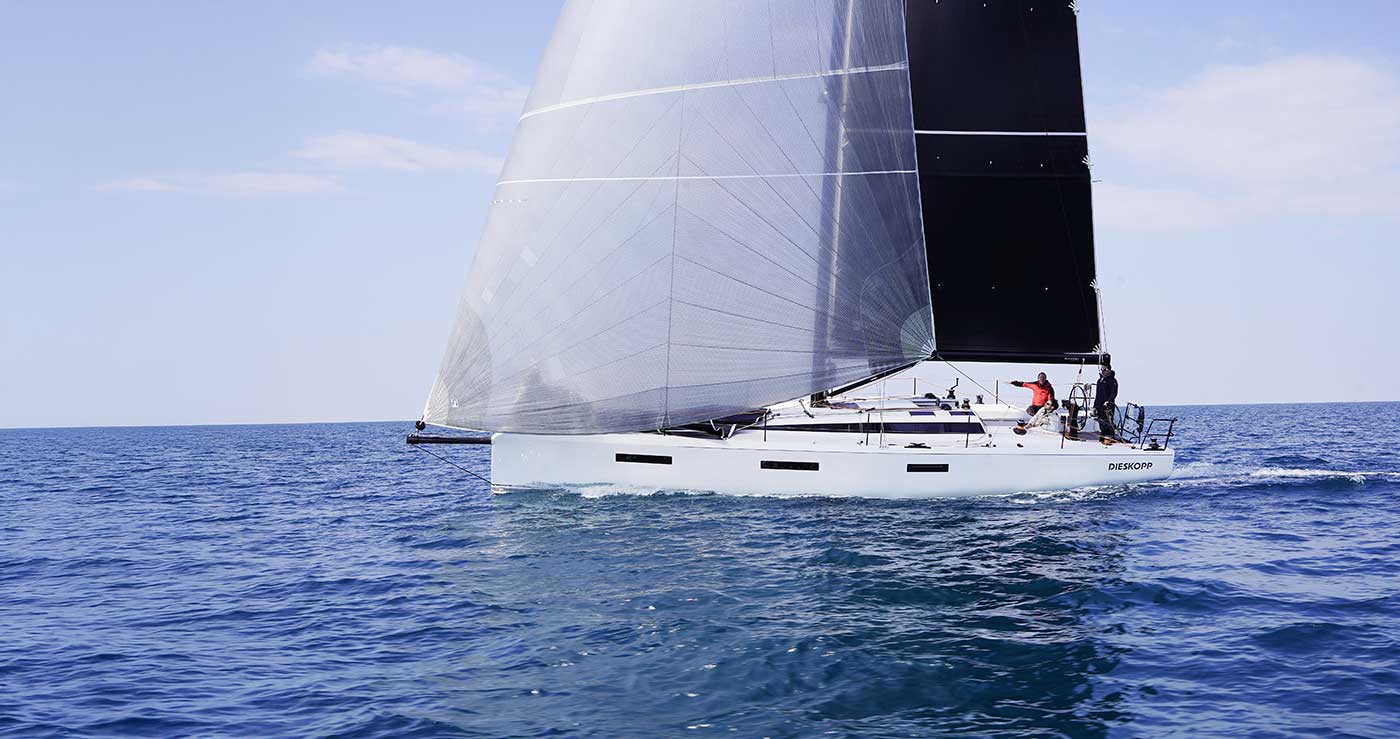
For decades, the cruiser-racer was the dream boat of almost everyone who longed to put to sea under sail. Ideal for cruising with family or friends, entering regattas and always going fast. The Italians were mad about them, the British devised rating systems for them, and they were built by the Danes, French, Finns and Slovenes, as well as by at least four yards south of the Apennines. Then they were undone by the volume and the number of cabins and bathrooms demanded by the charter market. Catamarans became the benchmark for comfort, while the mast often became little more than an ornament on which a sail is raised only on rare occasions.
Most of the large yards that once built them have almost forgotten they exist, while the others have closed their doors. The exceptions merely prove the rule. Yet there are still sailors who want to sail such boats, including some prepared to do whatever it takes to acquire the boat of their dreams, even if that means commissioning a one-off project or a boat built in only a handful of examples. Naturally, such boats come from boutique yards capable of meeting every requirement of their future owners and designers.
A Judel & Vrolijk Design
We had waited a long time to sail one such boat in the Gulf of Piran at the end of March. From the moment we learned that Gaber Bregant and his team at Oceantec were building a cruiser-racer designed by the renowned Judel & Vrolijk studio for a German owner, we wanted to see her. We have known Gaber for years and have sailed together aboard several of his boats, so an agreement was quickly reached. Once the boat was completed and fitted out, we would return to sail her.
And so, after a late-March bura, we met the Oceantec 43 Dieskopp at Marina Portorož, becoming the first people other than her owner and builders to do so. We never step aboard a boat like this without a sailor of reputation and experience. When we are in Slovenia, our Željko Perović Huck is invariably at the helm, for who could assess her better? Katija and I joined him. Our 20 years of experience sailing an X-43, the emblematic cruiser-racer from the beginning of the millennium, might also prove useful. But let us begin with the builder and the boat.
Compelling from the Drawing Board
Over its 20 years in business, Oceantec has established itself as a yard specialising in one-off and limited-production high-tech projects. These are usually sailing boats, although it also builds motorboats. The yard had previously collaborated with Judel & Vrolijk, building two JV43s, a design evolved from the Class 40. One of them, Red 2, has been dominating the regatta circuit.
Although she shares the same nominal length of 43 feet and the same designers, the Oceantec 43 is a fundamentally different boat and a distinctive project in every respect, from the hull, mast and rigging to the interior layout. Although conceived as an extreme sailing boat, she retains far more of the qualities of a traditional cruiser. In other words, she fully satisfies every requirement for six people to live comfortably aboard during an extended cruise, including cooking, storing food and clothing, sleeping in proper beds and dining around a cockpit table. Striking the right balance between racing and cruising, while also meeting the client’s specific requirements, is no simple task, and every designer will approach it differently. Judel & Vrolijk are true masters of the art.
An Extreme Sailing Boat
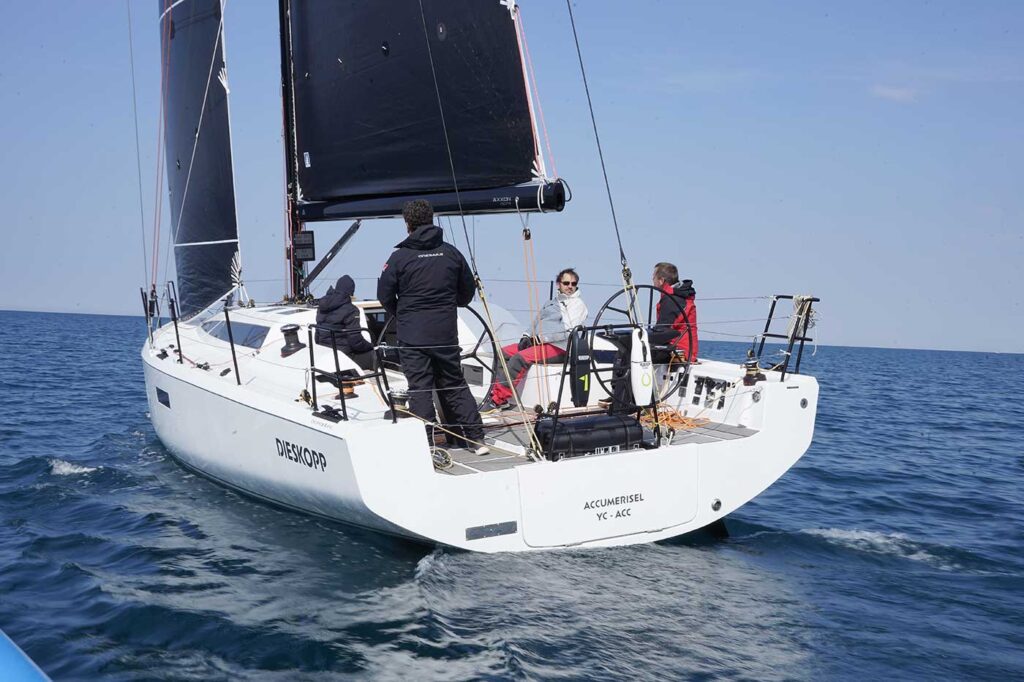
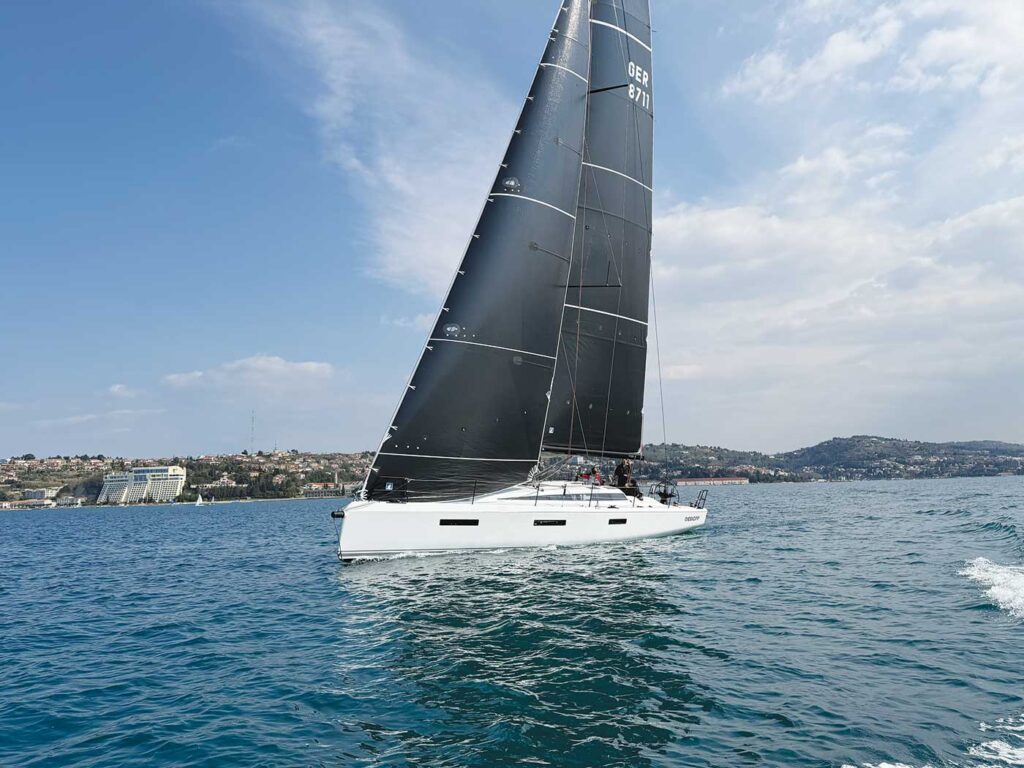
The mastery is evident at first glance, and still more so when you step aboard the Oceantec 43. She is an elegant boat with long, sporting lines, a low profile and a spacious open cockpit. The Axxon carbon mast and boom, together with her racing rig, say everything about her character. Nothing disturbs the beauty of those lines. To find the cruising element, however, you need to go below deck. Study the numbers and you discover that she is around 30 cm narrower than either the JV43 or the Pogo 44, which might serve as a comparison because of their almost identical length. Although the stern is very broad, it still tapers slightly from the boat’s maximum beam. Her mast is almost a metre taller and carries a few square metres more sail. There is also a considerable difference in weight. The Oceantec 43 is exactly 1.5 tonnes heavier, and that is the measure of the additional cruiser in her.
The Deck
We came to Portorož to sail, so we shall reverse the usual order of a boat review. We will begin with the deck, mast, rigging and sailing, then return later to the boat itself and the details of her construction. Conditions were almost ideal. The bura had subsided, but a north-westerly of between 6 and 10 knots remained over the water. We would have liked it to blow a little harder, but this was enough to form a clear impression of what Dieskopp can do. And she can do a great deal, with remarkable ease. We sailed for 4 full hours. Huck wore a beaming smile throughout and never released the helm except when the sails required his attention.
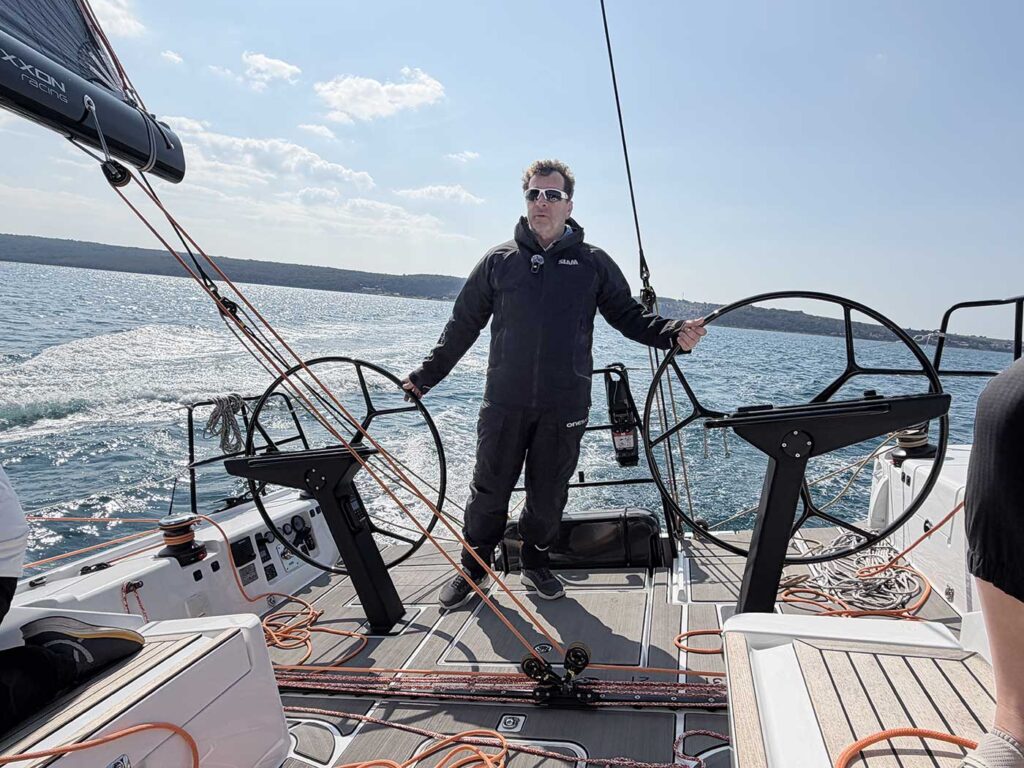
The entire cockpit layout is dedicated to sailing. Two carbon steering wheels, each mounted on a structure carrying electronic controls for the winches, ballast tanks and autopilot, give the helmsman an excellent view and complete control of the sails at all times. The cockpit sole is covered in non-slip material and includes the essential foot braces needed when the boat heels. The two benches provide seating for the entire crew. Four pairs of Harken winches, two for the running backstays, two for the mainsheet, two for the headsails and two for the halyards, are arranged so that two pairs are within reach of the helmsman or a nearby crew member. One pair is positioned amidships in the cockpit, while the halyard winches are mounted on the coachroof. Every winch is electronically controlled and can turn in both directions.
The Sail Plan
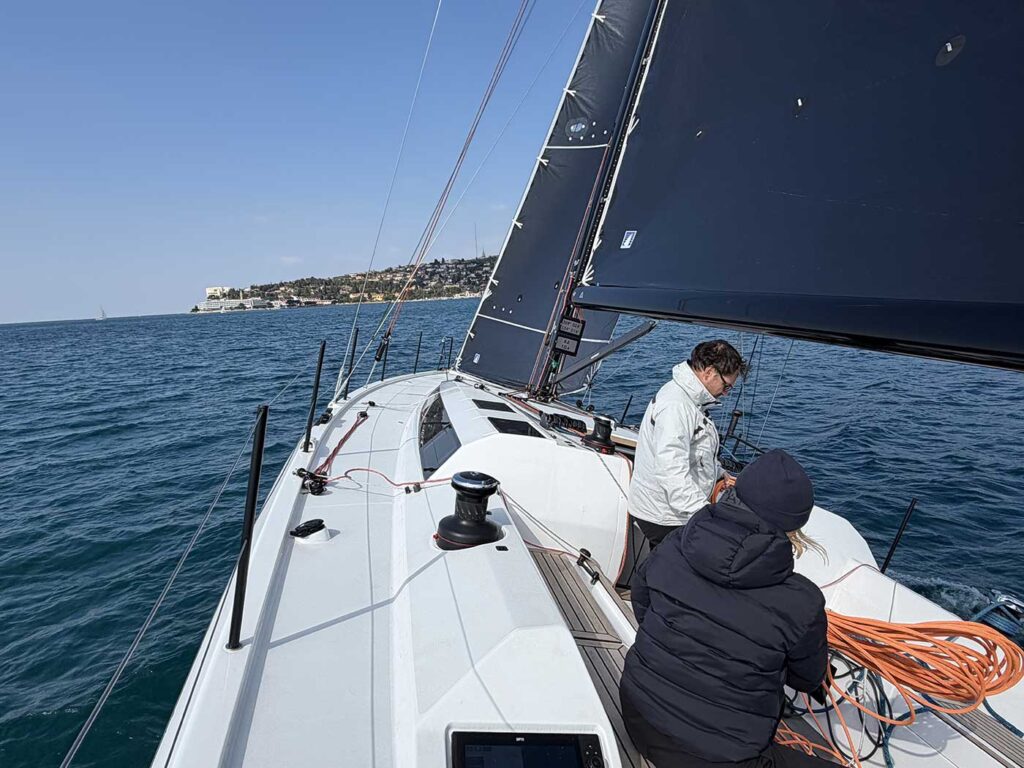
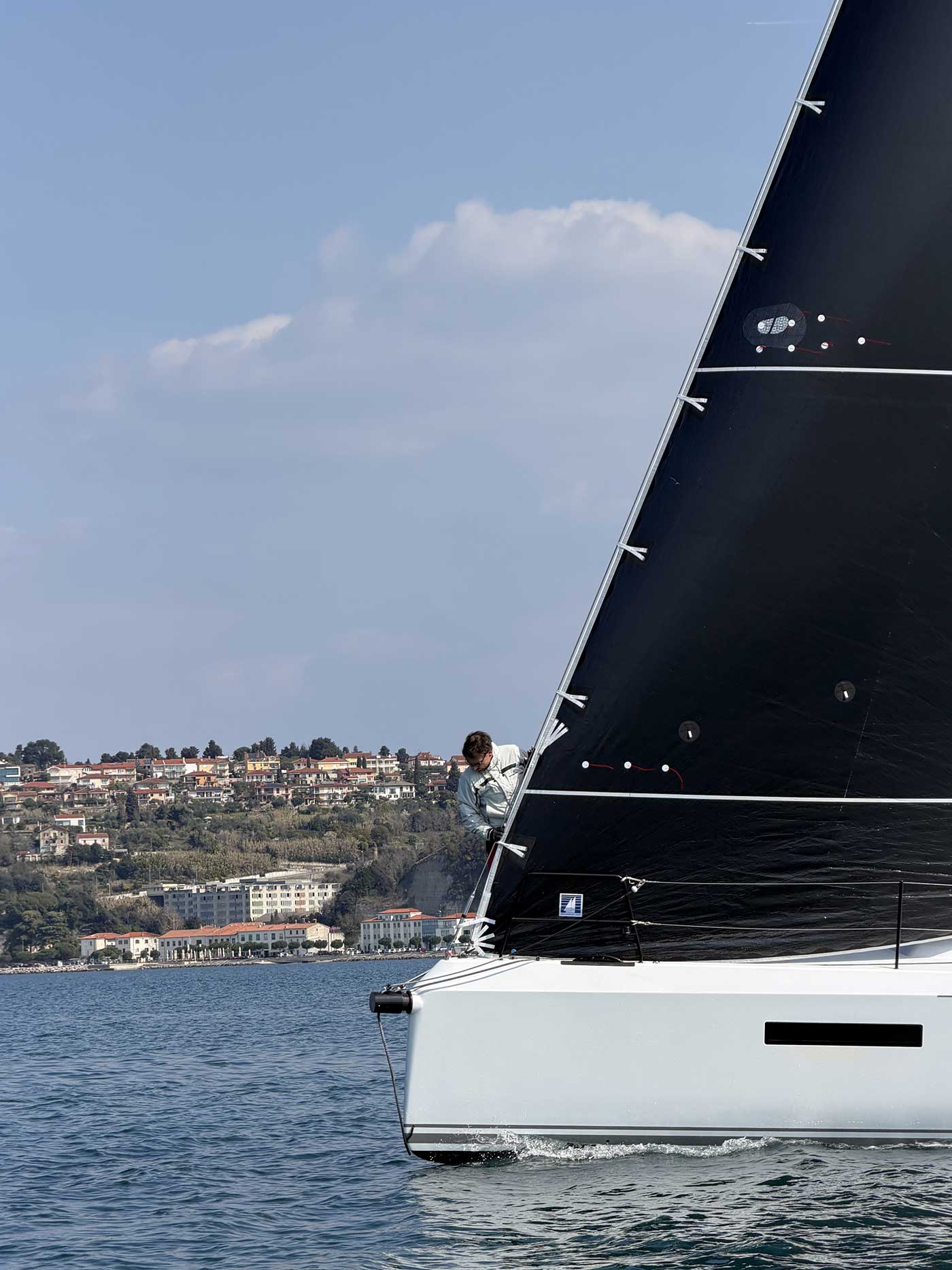
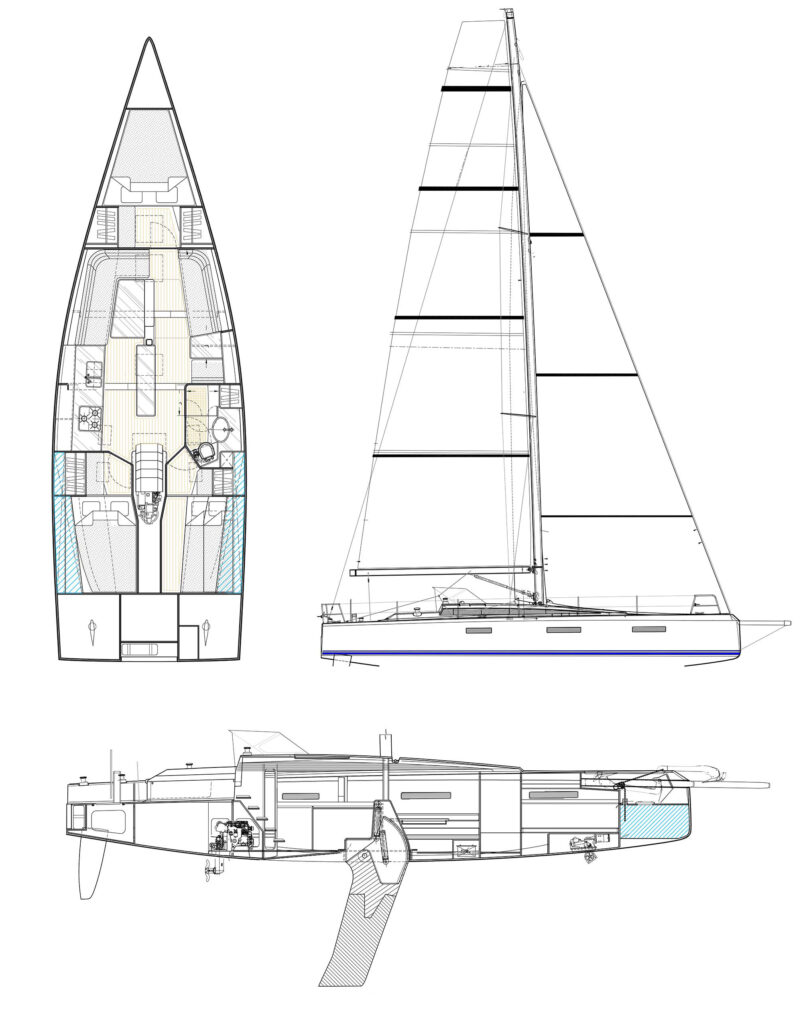
The boat carries a full set of Segelwerkstatt Stade sails, comprising three jibs, a mainsail, two gennakers and a Code 0, all of which are relatively straightforward to control. The sails are not made from the high-tech materials a boat of this calibre deserves. The 7/8 fractional mast, with two sets of broad spreaders, stands 18.9 m tall. It is stepped on the coachroof, the shrouds lead out to the sides of the boat, and the running backstays are secured approximately halfway across the stern. The jib is self-tacking and is conventionally hoisted and changed on the forestay. It can be reefed in the same way as the mainsail. The retractable carbon bowsprit incorporates a bobstay and is prepared for both the Code 0 and gennaker.
A Keel Designed to Take the Ground
The keel is a story in itself. It is a pivoting lifting keel with lead ballast in its lower section. The pivoting mechanism is built around a stainless-steel shaft with seawater-resistant bearings. As Dieskopp will be berthed in a part of Germany with a considerable tidal range, the keel structure has been engineered to support the boat’s weight when she settles on the seabed as the tide recedes. In this position, her draught is reduced from 3.15 to 1.25 m. The keel pivots using an electronically controlled hydraulic system, with a manual emergency pump provided in case of failure. The boat has two carbon rudder blades made by Isotop, a company specialising in composite rudders and foils. These too are engineered to withstand the loads imposed when the boat takes the ground at low tide.
Other important sailing features include three ballast tanks. Two at the stern and one at the bow allow the balance, trim and stability to be adjusted with precision. They are filled with seawater by electric pumps, can be filled and emptied rapidly, and are controlled at the touch of a button. The forward water-ballast system is intended to stabilise the boat at her berth, particularly when the keel is raised, ensuring an optimum attitude and balance.
Safety First
Safety has also received careful attention. Although the cockpit is open, its central section is protected by a solid carbon frame connected to the guardrails by safety wires. A liferaft is recessed almost entirely into the centre of the cockpit sole. Ahead of it is the hatch of a large locker suitable for storing fenders, while two Jon Buoy man-overboard recovery systems are mounted on the rail. Between the benches, two sockets in the sole receive the table legs when the owner is cruising and wishes to dine outdoors. Part of the transom can be opened to create a small stern platform.
Strong Performance
Huck handled the steering, trimming, tacks and gybes more or less single-handedly, requiring assistance only when changing sails. He was not fond of the electronic winch controls at first, but soon became accustomed to them. We began under the self-tacking jib, sailing mainly close-hauled with some time on a beam reach in a fairly light wind of between 6 and 7 knots. We then replaced the jib with the Code 0 as the wind strengthened to between 9 and 10 knots. Finally, we hoisted the gennaker in the same wind. Close-hauled under the jib, our speed generally ranged between 6.6 and 7 knots. With the Code 0 and gennaker, it never fell below 8 or 8.5 knots. For most of the time, we maintained more than 9 knots and occasionally exceeded 10. In that wind strength, we did not begin planing, nor was there any need to fill the ballast tanks.
Huck’s Verdict
“The Oceantec 43 is unquestionably a fast boat. At first, sailing close-hauled under the jib, we could not assess her performance precisely once she reached hull speed. In light winds, she takes a little longer to build speed, but she sails beautifully once she gets going. We did not have the 105% jib, which would also be worth trying. She performs very well under Code 0. You quickly reach more than 8 knots and, in 13 knots of apparent wind, she occasionally exceeds 10 knots. As soon as you carry more sail, the speeds improve immediately. She responds very well to gusts. In slightly stronger winds, she will certainly begin planing very quickly and should deliver strong performance.
“The feel at the helm is perfect. The steering is direct, so the boat remains under constant control. She is very well balanced, with good stability and an excellent displacement-to-sail-area ratio. She is relatively easy to sail. For my taste, there are too many electronic controls. Overall, this is an interesting performance-cruiser concept, or perhaps even a cruiser-racer with a long waterline. Compared with the JV43 we tested two years ago, she accelerates more quickly and sails at better angles to the wind. That boat was intended more for ocean sailing, whereas this is an all-round boat. She will also be highly competitive in windward-leeward racing.”
It is also worth mentioning that the 50 hp Volvo Penta engine with saildrive propels her at more than 8 knots, while a bow thruster makes manoeuvring in marinas and confined harbours considerably easier.
Comfort Under Way
Because the owner spends a great deal of time cruising, the designers chose not to create a spartan interior. Instead, they favoured the warmth of wood, proper wardrobes, a fully equipped galley and bathroom, heating and hot water. The only respect in which she differs slightly from the cruiser-racers of the past is the somewhat lower headroom in the saloon, which is still perfectly comfortable for someone 190 cm tall, and in the owner’s cabin, where a person 180 cm tall can stand upright.
A Classic Layout
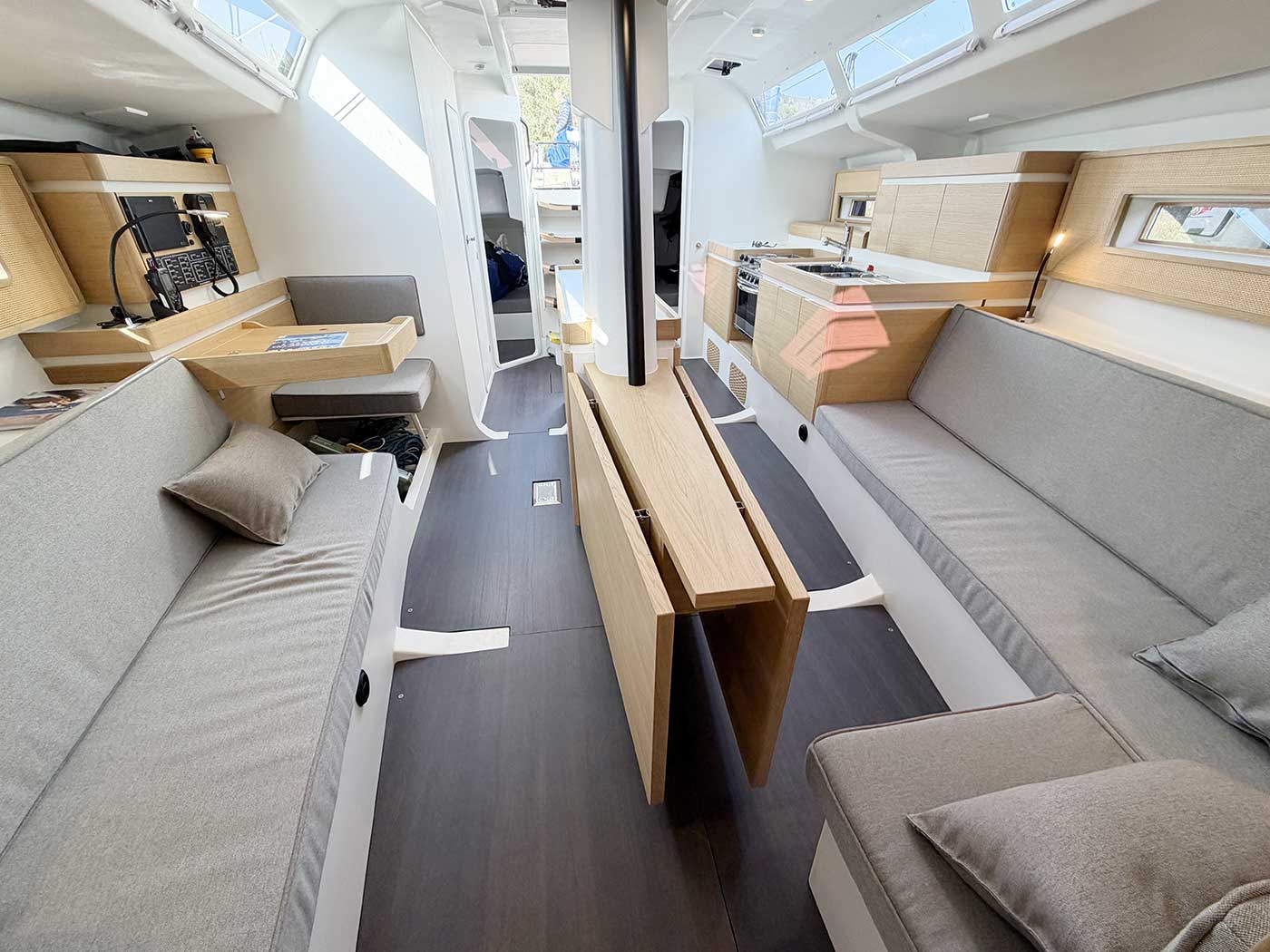
The saloon is exceptionally large for a boat of this size and considerably longer than usual. This is because the keel-pivoting mechanism occupies the centre of the entrance area, while the hydraulic equipment used to raise and lower it is housed in a box-like structure extending to the saloon ceiling.
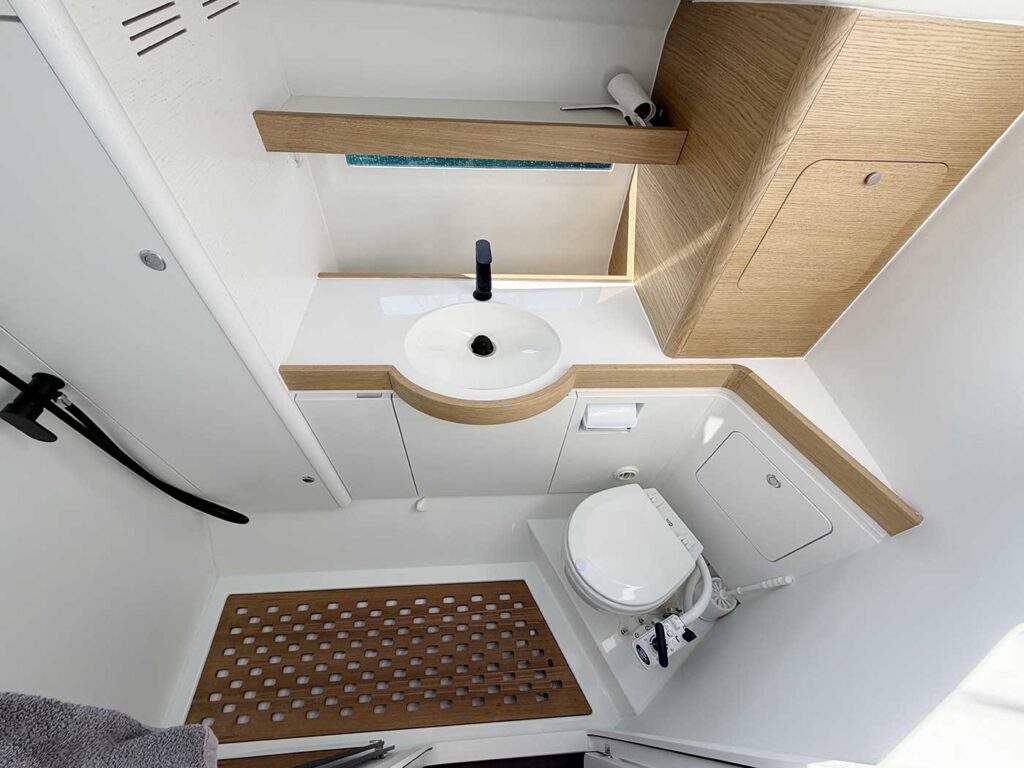
Otherwise, the layout is conventional. Four steps lead down into the saloon, their forward face enclosing the engine compartment. To starboard is the bathroom, with a toilet connected to the black-water tank, a washbasin, separate shower, locker for drying wet clothing and a portlight. Beyond it is that indispensable feature now omitted with increasing frequency, the navigation table. Further forward, a comfortable settee combines with an L-shaped settee to port and a large folding table to create an area for dining or relaxation.
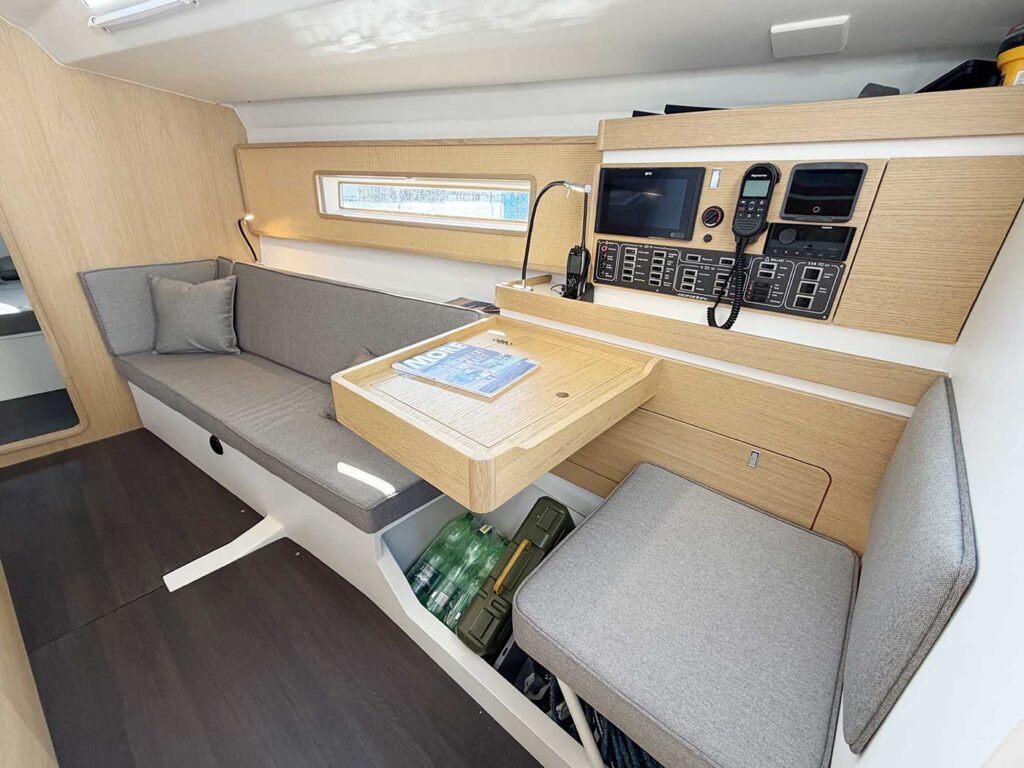
A generously sized galley occupies the forward port side of the saloon. Its 2.2 m worktop incorporates a 100-litre refrigerator, preparation area, three-burner gas cooker with oven and a double sink. Storage for cutlery, spices, plates, glasses, cookware and assorted provisions has been carefully planned, with a designated place for everything.
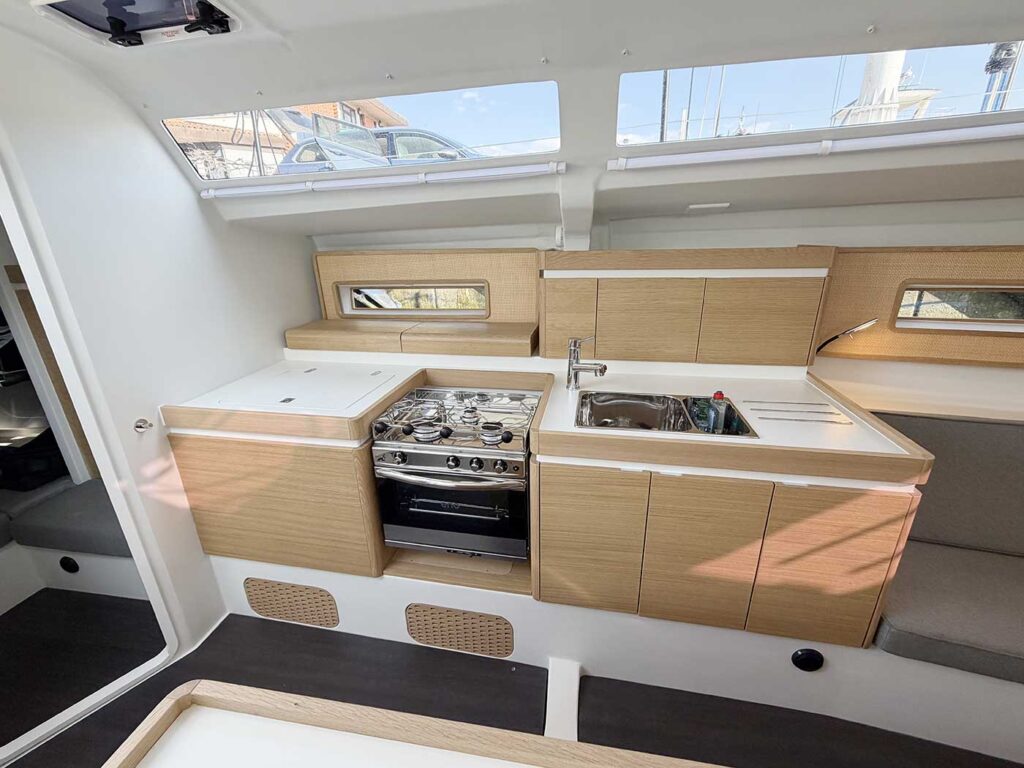
The saloon is filled with light entering through two glazed sections in the hull and the long coachroof windows. Two hatches are fitted overhead.
Spacious Cabins
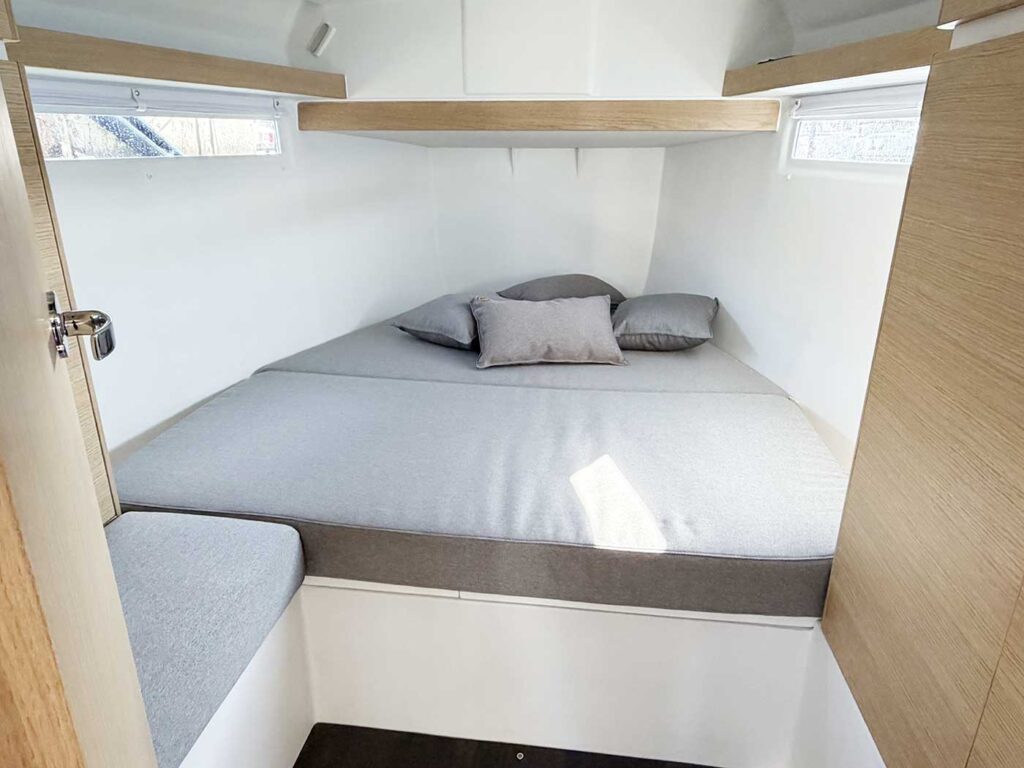
The cabins are relatively spacious for a semi-racing boat. The forward cabin contains a broad berth just over 2 m long, 2 wardrobes and a small bench. It too has glazed hull sides and a large deck hatch. In each of the aft cabins, an additional canvas bunk is fitted above the double bed. The wardrobe in the port cabin is slightly larger, while standing headroom is confined to the entrance area. Aside from the fact that 43 ft cruiser-racers were once designed with two bathrooms, offered slightly greater headroom and used considerably more wood, the Oceantec 43 lacks nothing required for comfortable cruising.
Construction
A boat intended for fast sailing, from which the utmost will be demanded at every moment, will not be treated gently and must therefore be exceptionally durable. The Oceantec 43 is built from fibreglass with a Corecell core and epoxy resin. A three-stage vacuum-infusion process produces a structure that is both light and strong. Every structural element, from the hull and deck to the bulkheads, has been designed as part of a unified whole. Additional reinforcement in key areas, including around the keel and mast, provides stability and safety even during demanding passages. Together, these features should ensure structural rigidity, optimum load distribution and dependable behaviour in all sea conditions.
What remains to be said at the end of an exceptional day under sail? Judel & Vrolijk have produced an excellent design. We can only envy the owner and congratulate Gaber and the Oceantec team on a job superbly done. Everything else has already been said.
OCEANTEC 43
Hull length: 13.30 m
Length at waterline: 12.65 m
Beam: 4.22 m
Draught: 1.25/3.10 m
Displacement: 7,800 kg
Mainsail: 65.5 m2
Jib (105%): 60 m2
Self-tacking jib: 50 m2
Code 0: 125.79 m2
Engine: Volvo Penta D2 50 hp
Fuel tank: 150 l
CE certification: A, ocean
Design: Judel & Vrolijk
Price: from €1,250,000
Boatbuilder: Ocean tec d.o.o.
Cesta F. Prešerna 62, 4270 Jesenice, Slovenia
email: info@oceantec.si
www.oceantec.si
TESTED BY Željko Perović Huck
EDITED BY More Editorial Team
PHOTOGRAPHY Marin Srzić