
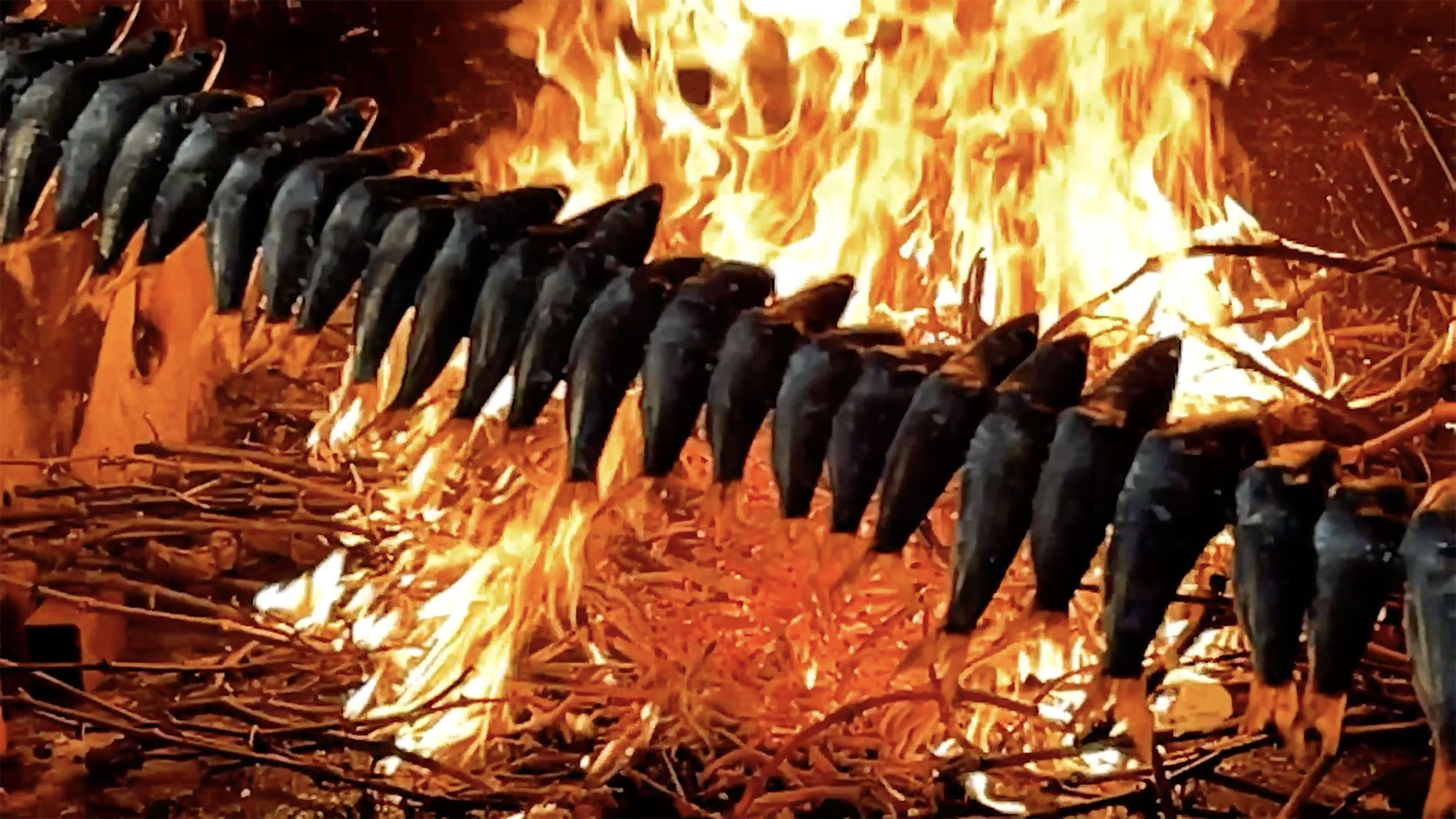
Much can be said about dishes made with sardines. Yet perhaps the most intriguing and improbable of them all is this small blue-and-silver fish cooked on a real, honest-to-goodness spit. An ox, a suckling pig or a lamb on a spit, certainly, but sardines?
Many will shake their heads in disbelief, and many will be mistaken. Sardines on a spit are elemental fishermen’s fare, a dish whose hedonistic simplicity reveals the full measure of their ingenuity.
During summer, when the fishing season for small oily fish is in full swing, preparing this dish will present you with a genuine challenge. Will the hour of marenda find the company gathered in some secluded corner of an island, or in someone’s courtyard beneath the cool shade of a grapevine? It hardly matters. The important thing is that everyone is gathered around the embers and the table. And that sardines are turning on the spit.
In Bulić’s Courtyard
We gathered in the courtyard of Jakov Dujmović Bulić. The grappa that Pape (Željko Novak) brought from his traditionally and naturally tended vineyard into the komin was soon making the rounds by the hearth. Pape had carefully carried in a long tube containing the spits, rolled up like the most precious scrolls from the Red Sea, or rather, from the Adriatic. He boasted that he had harvested the branches the previous January, under a full moon, and had somehow kept them perfectly straight. About the way he had prepared them, however, he wisely remained silent.
All the while, Jakov kept disappearing into the konoba to refill the bottles of wine that we were successfully emptying. He also brought snow-white sea salt, gathered with his own hands from crevices in the rocks where the sun had drunk the sea dry. Salt is the only seasoning we shall need.
To prepare sardines on a spit, however, you must select the larger fish. Once, this was not difficult. Today, when smaller specimens prevail in the catch, the more substantial ones must be carefully picked out. If “substantial” is a word that can be used for a sardine at all.

It All Begins with the Spit
The preparation of sardines on a spit begins with the spit itself. Do not shake your head doubtfully. Simply summon a little goodwill and a lively imagination, and set to work.
As you laze beneath a pine tree, occasionally cooling your body in the sea and refreshing both body and soul with a drink, try to be creative. Look for a common heather bush. It should not be difficult to find, as it is part of the maquis all along the Adriatic coast.
If you wish to prove yourself a true connoisseur, search for a laurustinus bush, also known locally as japrin or vemprima, and fashion a spit like Pape’s from this laurustinus shrub. Should you wish to display a particularly refined nose and palate, while dispensing a little unsolicited wisdom to the rest of the company, seek out gluhač, also called gluhi smrič or somina – the Phoenician juniper.
Each of these plants has its virtues and shortcomings, which will certainly provide plenty of material for conversation. They may even produce an unexpected adventure to add to that eternal fishermen’s tale of how sardines should be cooked on a spit.
The Woodworker at Work
A common heather bush is easy to find and simple to shape with a small knife. A laurustinus bush is a shrub of almost mythical status among fishermen: its branches are traditionally used to make the netting needles with which fishing nets are repaired, and a spit fashioned from it enjoys something of the same prestige. It is harder to find, however, because the branch you need must be at least 2 years old and properly woody.
Gluhač is easy enough to come by, but turning it into a straight, knot-free spit will test your patience. Its resinous wood, however, will impart a special savour to the sardines.

Break off the straightest branch you can find, around a metre long and no thicker than your index finger. Scrape away the bark with a knife, then try your hand as a marangun – a woodworker. Take it slowly; you have all the time in the world. Shape the round branch into a flat spit and sharpen its point well. If the mood takes you, carve the handle too. Pape has done precisely that, with an almost artistic flourish.
Once finished, you may rub the spit with oil, although this is not essential. An unwritten rule says that anyone wishing to eat sardines cooked on a spit must make their own. Unless the company agrees otherwise.
We agreed otherwise. Mladen took charge of the photography. Braslav circled around, searching for the best angle while watching Jakov and Pape at work. And someone, after all, had to write everything down.

To Be or Not to Be
Buy your sardines at the fish market, the peškarija, where, one assumes, they will be fresh. Run each one through your hand. Hold the sardine by the head between the fingers of your right hand. Gently encircle it with your left and draw your hand towards the tail, leaving the scales in your palm.
Salt the sardines in a bowl or deep plate and add a little pepper if you wish. That is all.
And now comes the “to be or not to be” moment, the crucial point. Before sardines can be cooked on a spit, they must first be threaded onto it.
Take care: every sardine must face the same way. All the tails should lie on one side of the spit and all the heads on the other – left and right. Arrange them so that the dorsal fin of each new sardine touches the belly fin of the one before it.
We shall follow this “method”, although the reverse is also possible: piercing first through the belly and then through the back, so that the belly fin of each sardine touches the dorsal fin of its neighbour.
It Is All in the Piercing
Pierce the first sardine through the back and towards the belly, then repeat the process with all the others.
Most importantly, and take care, or you may lose your delicious meal. The dorsal and belly fins must remain on one side of the spit, with the backbone on the other. The sardines must not sit loosely on the spit but be pressed snugly against one another. This prevents the wooden spit from catching fire, burning through and breaking.
The side with the backbones should face the embers first. Once you turn the spit, the bones will hold the sardines together and prevent them from falling apart into the embers and ash.
When turning the spit, use the palm of your free hand to help if necessary. Rest the point and handle on two small stones so that the sardines are suspended above the embers. Keep more heat beneath the heads and less beneath the tails. Make sure there are no embers directly beneath the bare sections of the spit, either under the handle, between its stone support and the first sardine, or beneath the pointed end. Otherwise, the wood will burn through at those spots and snap when you lift it.
The fire must be gentle. The best embers come from vine cuttings or slender, dry branches gathered from the surrounding shrubs.
Cook, Then Cover
A word of advice: do not place more than 10 sardines on a single spit. Unless you are as skilled as Pape. Cook them for a few minutes on one side and the same again on the other. Remove them from the spit with the help of a slice of bread, using it to push them into a dish. Cover them for 5 to 10 minutes so that they become even more succulent in their own steam. The same trick works for sardines cooked on the grill.
Although the rules of polite society dictate the use of cutlery, or at least a fork, make an exception this time and use the most regal utensils of all: your fingers. You will quite literally lick them clean.

A glass or two of wine goes well with sardines on a spit. White or red, it matters little, provided there is enough. Afterwards, seek out a deep patch of shade.
When you awaken, find your spit. It may make a fine keepsake.
Sardines on a Spit – Ingredients
Sardines – around 10 per spit, or as many as each person wishes
Spit – a branch of laurustinus bush, a common heather bush or Phoenician juniper, approximately 1 metre long
Salt – coarse sea salt
WORDS: Marko Vučetić
VIDEO: Mladen Šćerbe